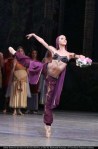
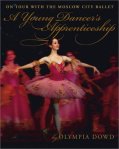
Ballet in Print: A Young Dancer’s Apprenticeship

A Young Dancer’s Apprenticeship is the fascinating story of Olympia Dowd, a very young ballerina who was selected out of a small summer program to apprentice with the Moscow City Ballet. Ms. Dowd was a true prodigy, with technique and artistry far beyond her years. Her exceptional talent comes alive in beautiful color photographs throughout this book.

The life of a student is very different from life as a professional with a touring company. If you are interested in becoming a professional ballet dancer or just enjoy reading about what that world is like, this book is the perfect choice for you.

When Awkward Leos Attack!

I’ll never forget my first ballet class away from home, standing at a barre in the middle of a huge ballroom with strips of marley duct-taped over red and blue carpeting. I’ll also never forget the sheer relief of realizing that the master class teacher’s annoyed comments after the first exercise were not directed to me, but to the dancer next to me who had been yanking her leo up in the front and down in the back incessantly. “Tell your mother to buy you a leotard that fits before you come to another class,” he said with complete seriousness. “If you have to pull it up and pull it down all the time, it doesn’t fit you!”

It had never occurred to me that adjusting a leotard was noticeable, let alone that it could turn into enough of a distraction for a teacher to ban it! We’ve all had That Leotard though … The one that you know will look totally gorgeous, if you can just have another sec to situate it just right …

Just like in street clothes, different cuts are made for different shapes. If you have a leo in your closet that bugs you no end, ask yourself why you are bothering with it? Endless tugging and yanking and wedgie picking – that’s right, I said it! – isn’t only a distraction to your own concentration, it’s annoying to your teachers and can make you seem unprepared and unprofessional. Um, not worth it!

Rest assured, the issue has nothing to do with you or your body. It has everything to do with one simple fact. Are you ready for this revelation?

People come in different shapes!

Shocking, I know. My longer torso was the cause of all my leotard tugging. Certain brands and cuts will never sit right on me – but others look simply fabulous!

Teacher annoyance aside, if you aren’t comfortable in your dance gear, you can’t put your all into your training. Don’t waste your time fussing with an awkward leo. Next time you’re shopping for dance clothes, try on as many different cuts, brands and fabrics as possible until you find what combinations look and feel great – so you can stop thinking about your gear and just focus on your dancing.
Ballet in Film: Ballerina

One my absolute favorite dance documentaries, Ballerina, is now available to watch instantly on Netflix. This exquisite portrait of five female ballet dancers from the legendary Kirov is a relatively recent film, which lends it a much more modern air than most dance documentaries available, particularly when it comes to the level of virtouosity of the dancing itself. If you are looking for true inspiration and to see just how elevated a level ballet can reach, I highly recommended you check it out.
When Can I Go on Pointe, CBT?

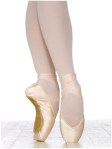
Every beginning female ballet dancer dreams of going on pointe, but that dreamy day can and will be ruined by pain and injury if you are not prepared. I don’t want to scare you but I have witnessed the pain and frustration of an ill-prepared beginner pointe student! It is far more difficult to overcome poor pointe technique resulting from ill-preparedness than to simply wait until the dancer’s strength and technique are ready.

It is your ballet teacher’s job to know from experience and education when his or her students are ready, but surprisingly few ballet teachers actually share that information with their students. There can be many reasons for this. Some teachers are concerned that if they explain the details of why, students and parents will be encouraged to argue about whether their daughter fits the parameters. Other teachers like to encourage a certain mystique about the whole affair (though they’d never admit this), thus generating further suspense and excitement for the students and parents and securing the teacher’s perceived status as a guru of super secret sacred ballet info.

I do not subscribe to either of these philosophies. In fact, I believe that transparency in these matters is vital for the dancer’s education! It is with that in mind that I share with you my guidelines for pointe preparedness. Mind you, these are not hard and fast rules, and it does take the teacher’s expertise to know if the dancer has actually met a given requirement. So without further ado:

  1. A student must be 11 years minimum to allow proper bone ossification. When children are young, the growth plates are soft, and repetition of improper technique in something as strenuous as pointe can deform the feet and body in short order. It is common for dancers to have to wait until they are 12 or older so their technique and bones can strengthen.
  2. A student must have at least 2 consecutive years of quality training immediately prior to promotion. Length of training is not an estimation of pointe readiness, however.
  3. A student must be in good health and able to take a whole class. This includes being of healthy weight. If the student frequently needs to rest because of illness or injury, she is not strong enough for the extra demands of pointe work.
  4. A student must consistently take a minimum of two classical ballet technique classes a week. Daily class is preferred and necessary for students training for ballet as a profession. Class frequency makes a significant difference in development.
  5. A student must pay attention in class and work well. Going on pointe is a big step and requires commitment on the part of the student.
  6. A student must be responsible enough to bring all the gear she will need to class. Pointe shoes require extra care and accessories.
  7. A student must habitually use her core muscles properly and have a strong, proper posture while dancing and standing. Pointe requires that the student use the muscles in her torso, legs and feet to stand en pointe and not use the shoes as a crutch. Core weakness will throw the student off balance and will make it difficult to dance.
  8. A student must use correct plié while dancing and exhibit supple calf and leg muscles.
  9. A student must hold turnout from the hip while dancing. Turnout makes it possible to do steps that could not otherwise be done. If the student does not maintain their turnout, they are not strong enough for pointe.
  10. A student must keep the heels forward. (No sickling, a sure sign of improper technique.) The most stable position for pointe work is to have the weight slightly forward between the big and second toes. Improper center will make it more difficult to stay en pointe, and will increase the chances of strain and injury.
  11. A student must point the whole foot from the ankle and instep with toes pointed but long while dancing. These muscles need to be strong enough to support the body weight. If the student is not in the habit of articulating the foot muscles properly, they will not be able to support themselves en pointe.
  12. A student must have enough of an arched instep to stand on pointe. Dancers with very high arches often have weak alignment or weak muscles that they must first master.
  13. A student must execute properly 16 relevés in the center without stopping and 8 at the barre on one leg without stopping, right and left. There should be no pumping action through the upper body during this execution. Strength for pointe work is achieved by repeating exercises. Relevés are excellent for building calf and leg strength, which is vital for pointe. If foot and leg strength is an issue, Theraband exercises can improve this deficiency.
  14. A student must pique passé/retiré with straight leg and proper alignment. Student should have enough strength to push themselves onto half-pointe. This step is harder to do en pointe and a bent leg is a sign of weakness or improper step preparation.
  15. A student must hold a retiré balance on half-pointe. The student should be well-placed (hips square, back straight, legs turned-out), and have the strength to balance on half-pointe. This pose is more difficult to correct en pointe, as the surface area for balancing is smaller and the turnout strength requirements are greater.

Most syllabi dictate that working properly in ballet class is sufficient preparation for pointework. As mentioned above, special exercises may be prescribed to help the dancer who is behind her classmates. Some schools devote whole classes to this preparation, called Pre-Pointe. There are varying philosophies on its appropriateness  – but that is a topic for another day!