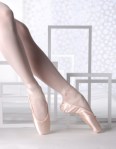
Fits Like a Glove – For Your Foot! – Part 1

There is more to fitting a pointe shoe than finding the right shape, though shape is integral. Each part of the shoe should be checked and the overall fit should exhibit certain characteristics. How do you check for these things? How do you start the fitting once you’ve chosen shoes based on shape?

First off, you need to get the correct size for the brands you are going to try. The best way to do this is to have your foot measured on a Brannock device. Stand with one foot on the device with the heel all the way against the back, and make sure the feet are parallel. Measure with the weight completely on the foot being measured. Find the appropriate width and arch length. Next, measure with the weight off the foot being measured and note change in width. (This is how you measure metatarsal compression.) Measure both right and left feet because their may be a difference. Now, put on the first pointe shoe you want to try on.

Be sure toenails are neatly trimmed and the drawstring is properly pulled and secured. Standing flat, pull slowly and carefully criss-crossing the ends parallel to the floor, not upward toward the knee. When pulling the drawstring, be sure both ends are completely free and that there are no knots. Always pull both ends evenly, so that you don’t lose one end inside the binding. The drawstring should feel snug, not tight, to avoid irritating the Achilles tendon. Tie securely. Stand in second position and grand plié. This will put the foot in its longest position. The toes should just barely touch the end of the box, without feeling crunched or smashed.

Set a foot en pointe with no weight on it. You should be able to pinch 1/4” to 1/2” at the top of the heel near the drawstring casing to ensure that there is enough room for the toes when rolling up through pointe and when standing flat. If you can fit a whole finger in the back of the shoe it is too long. If you cannot pinch any material it is too short.

Many dancers are fitted in shoes that are too short, and compensate for the discomfort by increasing the width. A foot that is a true wide is the exception. Shoes that are too short and wide cause great pain. Dancers will do almost anything to alleviate it, including wearing padding that only exacerbates the problem. If a dancer has enough room for bulky pads, the shoe is not properly supporting the sides of the feet.

Now that you have the correct size in the shoes you are trying on, you will need to check the fitting for proper width, box, vamp and shank.

For the box and width: Focus on how your toes and the ball of your foot feel. Are toes held tightly together (no wiggle room) without being pushed on top of each other? With a perfect fit, the edge of the hard part of the box does not show through the satin. The shoe should be snug enough that you can barely slide a finger into the shoe a bit at the top of the foot. If you can fit a finger easily in the throat or sides of the shoe it is too wide or the box is too big. The foot should fit snugly against the top of the shoe. Additionally, the strengthened wing of the shoe should be high enough to just cover the big toe joint, while not restricting demi-pointe.

The compressible foot should be fitted carefully and might need a narrow box or a boxliner. Pointe shoes must not be too narrow. Allow enough width for demi-pointe. If a shoe is too tight, the metatarsals and toes may be constricted and unable to move properly. This can compromise fine control of the forefoot. The front of the shoe should be sleek and snug, but not so tight that bunions bulge or the edge of the box digs into the bunion from underneath it. Shoes that are too wide are unsupportive and can cause great pain. Too tight shoes or shoes or those that are too tapered can promote bunions and cut off circulation.

Next, check the vamp and the strength of the shank: When on pointe, the foot should be over the platform, not held back, over too far, sinking in the box or popping out of the box. In general, short toes want short vamps, long toes want long vamps. The vamp should be long enough to keep the dancer from popping out of the shoe, but short enough to not restrict demi-pointe.

A less flexible ankle is often helped by a shorter vamp, but make sure knuckles and bunions are totally covered. Dancers who go over too far despite deep vamps and straight, stiff shanks should try vamp elastic. If the shank twists noticeably away from the sole of the foot, check the dancer’s alignment and be sure the shoe is not too narrow.

In general, the lighter and more flexible the shank, the easier it is to roll through demi-pointe and to get over the platform. Flexible shanks allow a dancer to achieve a higher demi-pointe before attaining full pointe, and they readily conform to the foot. They are beneficial for less flexible ankles. Professionals often prefer softer shanks because they can better control their shoes.

Firmer shanks may be necessary to prevent a dancer from going over too far, which can overstretch the ankle and hinder placement. Harder shanks are required by dancers with highly arched feet and by those who are tall and big-boned, but they give more resistance in rolling through demi-pointe.

(¾ shanks should never be used to help a dancer get over. Doing so will cause the dancer to sit on the shortened shank and encourage Achilles tendinitis due to the clenched tendon trying to hold the foot in the en pointe position improperly. Sitting is the danger for those new to pointe, because if they are not taught to pull up out of their shoes, they will sit in them. While you can sit in any pointe shoe, ¾ shanks make it easier for lesser experienced dancers to sit in their shoes. I do not allow beginner pointe students to wear ¾ shanks!)

In part two of this article, we’ll finish up this fitting and talk about toe pads.

Ballet = Mad Skillz Versatility!

It’s true! Dancers who begin their study with solid training in ballet are preparing themselves for maximum versatility for other dance genres. And here is an article on this very topic.

In my opinion though, it is important that other forms of dance like modern, hip-hop and tap be introduced soon after an intermediate level of ballet is reached by the student. We can’t all be Alex Wong! – Most dancers have to learn how to use their ballet training to explore new ways of moving in space. But like the article says, it rarely if ever can work the other way around.

Dancewear en l’air: The Corset-Style Camisole

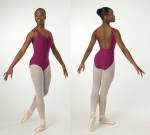
This striking two-tone leotard, 107-ROY from By Marisa, flatteringly mimics of the bodice of a tutu. What makes this item special is the contrasting black trunk and trimming combined with corset-style seaming on the bodice.

This isn’t an item that you want to cover up with a skirt or sweater – add it only to your favorite pink tights to avoid an overly busy look and just let the leotard’s lines accent your own. This leotard is also available with a white or red top by different model numbers.

Square Foot, Round Shoe?

In the U.S., anyone can open a dance studio or dancewear shop – no regulated training or certification required. And this is a good thing for a lot of reasons. Even principal dancers have no document proving their abilities – their careers just speak for themselves. This does mean, however, that a lot of unqualified people get to open studios and shops regardless of their training. When it comes to a dance technique as advanced and specialized as pointe, the results of their undereducated counsel can be devastating to a growing dancer.
What can you do about this? First, you must research the background of your teacher to make sure she is well qualified. A professional career, training at highly ranked dance schools, and pedagogical study are things to look for. Unqualified teachers are rarely educated in or enforce pointe readiness parameters.

Second, educate yourself before you walk into your first pointe shoe fitting. To help you out with this, I posted basic pointe shoe terminology yesterday. Today, I’ll give you an intro to basic foot shapes and how to choose pointe shoes that make sense for each.

You should look for a pointe shoe that mimics the general shape of your foot. Feet come in many shapes and sizes, but the basic common shapes are:

  • Greek or Morton’s: This foot type has a long second toe. The rest of the toes are shorter. The width tends to be narrow to medium. These feet tend to prefer a somewhat tapered box.
  • Egyptian: This foot type has a long first toe. The rest of the toes taper. The width tends to be narrow to medium. This foot tends to prefer a tapered box.
  • Giselle or Peasant: this foot type has at least three toes the same length (sometimes more). The toes tend to be short and the width medium to wide. This foot usually prefers a square box.

Stand on flat parallel to a mirror and examine your foot. Is it flat against the floor? Do you have a high arch that protudes upwards?  Or do you have a foot height that is somewhere in the middle? This will affect your selection for the profile of the shoe.

Lastly, look down at your toes. Are they very long, short and stubby, or just medium length? This will affect the vamp length that you need.

Using these three basic parameters (footprint, foot height and toe length), you can choose which shoe types to begin your fitting with. In order to do that, however, you need to know which shoes mimic these shapes.

Unfortunately, marketing departments of pointe shoe manufacturers do not always give correct information in their pointe shoe descriptions. But there are researchers out there who carefully measure and examine pointe shoes for historical and scientific purposes. This is where you can really get good data on what shoes exhibit each feature that you need. My favorite pointe shoe resource is The Perfect Pointe. The researchers from this group have compiled an invaluable Master List of Pointe Shoes, which is an easy to use chart for choosing shoes with the features you need.

Following this basic guide should get your fitting off to a good start. In upcoming posts, we’ll talk about choosing a size (It’s not like street shoe fitting!) and examining each shoe you try for proper fit.

So is vamp short for … vampire?

Uh, that would be a no. Kiddos, if you want be a ballet dancer, recreationally or professionally, you gotta speak the lingo. So today, let’s talk about the language of pointe shoes. And to talk about that, we have to understand how they’re made.

To create a traditional paste shoe, the fabric, leather and other components need to be shaped on a form, or last. Layers of canvas, burlap or muslin with paste and sometimes flour are often hand-formed for the box, baked for hours, and dried for sometimes weeks. Often, shoes are formed from the inside and then turned right-side-out for the final touches like binding. Most pointe shoes have no left or right until they are broken in by the dancer. (Just to clarify for the real newbs out there: There is no wood tip or block in a pointe shoe!)

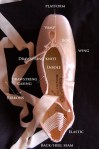
Each part of a pointe shoe, from the tip or platform on which the dancer balances when on pointe, to the thin and carefully sewn drawstring cover, or binding, has a name. So just for you, I’ve compiled this glossary of basic pointe shoe terms that you should know:

Binding: the fabric channel through which the drawstring runs

Box or Block: the stiff toe cup that encases the toes

Box liner: the soft fabric that lines the inside of the box

Crown: the vertical height between the vamp and the sole

Girth: the measurement around the widest part of the foot, at the metatarsals at the ball of the foot

High Profile: a pointe shoe box, often cylindrical, with a relatively large space between the outer sole and the top of the box, better for higher insteps.

Last: A last is designed to create a shape by replicating the form of a dancer’s foot. Every style, size and width requires its own last.

Low Profile: a pointe shoe box with a generally flat shape and a relatively small space between the outer sole and the top of the box, better for lower insteps

Metatarsals: the five bones between the ankle and the toes. Pointe shoe fitting is especially concerned with the area near the ball of the foot.

Outer Sole: the bottom part of the shoe, usually made of synthetic or leather, which is in contact with the floor when the dancer stands in the normal flat position

Platform: the part of the pointe shoe on which the dancer stands when en pointe

Pronation: the rolling inward of the foot so that when standing flat, more weight is on the ball of the foot than on the outside

Quarter: the part of the shoe covering the sides and heel of the foot

Shank: the stiff insole that provides support; Created from the leatherboard or redboard, this is the backbone of a pointe shoe. It is located under the socklining and provides support to the arch. A dancer’s strength and technical ability determine shank preference.

Side Wings: Side wings are an extension of the box and provide lateral support.

Side Quarters: the sections of satin from the side seams to the back of the stay

Sockliner: the soft fabric that lies directly underneath the foot and runs the length of the shoe

Sole: Made of either buffed or scored leather to provide traction, the sole is internally stitched to the upper.

Stay: fabric that covers the seam in the back of the shoe at the dancer’s heel

Throat: open area located between side seams at the center front of the shoe is the throat. It gives shape to the upper which accentuates a dancer’s arch.

Vamp: the section of the shoe “upper” measured from the platform back to and including the binding. A longer vamp can help draw the foot closer to the shank for more support on pointe, so that the foot doesn’t overextend.

Vamp Elastic: wide, firm elastic sewn at the throat of the shoe to extend the vamp and cover the top of the foot

Winged Box: a box with extra-long, stiff sides

Core Competency: Pilates to the Rescue!

Do you struggle when you teacher asks you to engage your core during battements, balances and turns? The core muscles – not to be confused with the muscles that create a six-pack – are vital for a dancer in any genre. Ballet especially, with its specific and sustained demands on your posture and alignment, constantly uses the concepts that pilates specifically addresses.

Control of your core or “powerhouse” goes hand in hand with dance and is fundamental for proper ballet and pointe technique, but it can often be one of the most difficult things to master. Your torso has layers upon layers of muscles. Generally, the core refers to the muscles from your abs, sides and back at the deepest layers which are designed to provide support to the spine. Of course, if you are looking to get that six-pack look (which is created by the more superficial layers of the abdominals), core training is still an important part of reaching that goal.

Pilates was created by Joseph Pilates, a prize-winning gymnast from Germany. This method is alive and well today because of its consistent and excellent results. Pilates opened his first studio right alongside a number of dance studios, and Pilates soon became an integral part of the dancers’ regimen.

Many ballet schools provide classes or even require them for their students. If you are interested in Pilates training, look for a certified instructor. Ideally, find a former dancer or dance teacher that understands the complexities of Pilates as it is intended for dancers. Private lessons are fantastic for beginners. If you don’t know where to look for a qualified instructor, check out the Pilates Method Alliance® for a list of first-generation teachers (who studied under Pilates and his wife) and to search their PMA Pilates Certified Teacher database.

Ballet in Film: The Corella Ballet Documentary

Ok, so if you were born after 1995, you might not have had the googly-eyes for Angel Corella during his tenure as a completely adorable principal dancer of ABT and Paloma Herrera’s often partner. But you can now if you watch him and his own ridiculously gorgeous company dancers in their fab new upcoming documentary!
This film is about Corella’s revival of ballet in his home country of Spain, which went without a major company for a long time until Corella decided recently to start his own, the Corella Ballet de Castilla y Leon. Thanks once again to DanceMedia, you can enjoy the preview trailer, which includes tantalizingly long snippets of company class, rehearsals and performances, including Corella himself dancing and teaching, during their preparation for my personal favorite ballet, La Bayadére. Try not to drool!

For those of you that reside down South here with moi, Corella Ballet will be performing in New Orleans on its 2011 tour, and you can check that out here.

Dance Unions & Contracts: Meet AGMA

AGMA is the American Guild of Musical Artists, and if you’re thinking of dancing professionally, you could one day be a member. AGMA is a union of professional performing artists, including musicians, opera singers and dancers. AGMA negotiates contracts with performing companies, administrates retirement funds, posts auditions and hosts a relief fund for members in need.

If you are interested in dancing professionally, you might like to check out this page to review AGMA union dance contracts of some major companies for the current and recent past few years.

Dancewear en l’air: The Low Square-Back Tank

Prima Soft came up with a beautiful square cut for the back of its leotards a few years ago, and its still gorgeously flattering today. This angular, low cut on a classic tank style, 501, keeps the leo from looking too much like a swimsuit, which is sometimes how a tank leo looks with a low scoop back. The pinched front of this leo is equally flattering.
The versatility of this tank is great. It would look equally beautiful with a wrap skirt or without. Clean lines, classic styling and traditional colors make it ideal for even fairly strict dress codes.

Tis the Season – for Casting Stress!

Fall audition season is wrapping up and cast lists at tons of schools are either in the works or already posted. Welcome to casting season! Have you been waiting with bated breath to scan your school’s bulletin board for your name? Do you already know what parts you’ll be working on this year? Is it stressing you out? How are you dealing?

You know casting season can be tough. After a year of hard work and maybe a summer intensive or two, a lot of students dream of solo or even lead roles, but not everyone is going to get what they want. If you are still waiting for your cast list to be posted, how should you deal with the pressure of the wait?

When you start thinking about that elusive cast list and all the “what ifs” that you cannot control, turn your mind to the things that you do have control over. Ask yourself, what should I be working on in class to keep improving? What are my goals for this year? Most teachers will be more than happy to talk to you one-on-one about what you need to improve most and how to go about focusing on those issues. Working on strengthening specific areas of your dancing will help you to continue on a path to success regardless of how the casting turns out.

Have you already found you name up on the casting list? Did you get the parts you hoped for? If not, are you motivated to work harder? Or are you busy picking apart the students who got the roles you wanted? If the second one sounds like you, it may be time to take a deep breath. Casting season is often when rumors about favoritism and politics take hold and may start running rampant among students and even – shockingly – among parents. Don’t get caught in this spiral. All it will do is keep you from focusing on you and how to get where you want to be.

I know it can be hard – especially if you have friends or even parents telling you that you deserved the role that Suzie got, but I promise that 99% of the time, casting decisions are made with careful attention to countless factors. For example, different students need different treatment at different times in their growth – Sometimes a students needs to be pushed to handle a solo role, and sometimes they need to be pushed to learn how to dance as a team member or team leader in the corps. Once again, the solution is to shift the focus from other students back to yourself. Focus on your dancing, what you need to do to move forward and how you can work on things that might be holding you back.

Finally, if you got that coveted role you’ve been dyin’ for – Congratulations! But remember, the work doesn’t stop here. An important solo or lead role can mean much longer rehearsal hours and a tougher standard that you need to meet. A lot more may be expected of you than you’ve had to deal with before – and you’ll still need to get all of that homework done! Take advantage of the guidance that your teachers and directors can provide.

However the casting chips may fall, remember congratulate yourself for working hard and getting through a competitive audition process. And get ready to rehearse your butt off!

Is a pro school right for you year-round?

I’ve often talked about how crucial training at a professional ballet school can be for students who aspire to a professional career, a high quality college dance career or both. Here is some great advice from the recent issue of Pointe Magazine about deciding whether a year-round program is right for you – and whether you are ready for it.

Dancewear en l’air: The Two-Tone Practice Tutu

In my recent post on the tutus, I featured this lovely rehearsal piece, C705, by Primadonna Tutus as the example. But such a well-made and economical piece really deserves it’s own post.

This practice tutu comes in classic white tulle. The black and white basque mimics the pointed basque-waist of a performance tutu’s architecture when worn with a black leotard as shown. This is a gorgeous rehearsal piece, but if you are looking to dress it up for a competition or recital, be forewarned that the two-tone feature doesn’t really lend itself to evolution into anything else. Primadonna offers all-white and all-black options if you need that versatility.

The price is nice on this piece and options include a 12″ or 14″ skirt, a hoop on request for $20 more, and either eight or ten layers of tulle. All told, you’ll probably won’t even reach $200 for the most expensive version.

Ballet for the Teen Beginner – Part 3

If you are getting ready to take ballet for the first time, you might want a heads up on what to expect, from what the barre is really for to what the teachers expect from you.

When you arrive, find out where to put your dance bag and purse. If you need to change, find out where dressing or restrooms are available. You should be in your dancewear with hair pulled back and completely ready to walk into class five minutes before the start time.

Exercises in ballet follow a certain general order. The class is begun at the barre, which you are probably familiar with from movies and TV as a railing that is used by dancers for warm-up. The barre is intended to be a light support. You should always practice at the barre as if you will eventually perform the exercises without it – because you will! Hanging on the barre or gripping it are huge no-nos.

When you walk into class, the first thing to do is introduce yourself to the teacher. Even if you met her during your enrollment, it is helpful for her if you re-introduce yourself.

Next, find a spot at the barre about four to five feet away from anyone else so that you can perform your exercises without kicking or bumping someone else accidentally. There’s definitely an unspoken rule about who gets what spot at the barre. Students who have some seniority usually have favorite spots that are considered theirs. Wait a few seconds before choosing your spot so you can avoid “stealing” one from one of these students.

If it’s the first day of class for a number of students or if it’s the first day of the year, the teacher might go over some class rules. In case she doesn’t though, here’s the basic rundown of what’s expected:

  1. When you are in the studio, speak only when prompted or raise your hand when you have a question, even if class is over or hasn’t yet begun.
  2. Ask for permission to leave the room or leave early, and ask in advance if at all possible. Never arrive late. If you absolutely must, enter the room as quietly as possible. Do not enter or exit the studio during a combination.
  3. Adhere to the dress code. Be neat and clean. Do not wear ill-fitting items or those in disrepair.
  4. At the barre and in the center, do not get so close to others that you kick or bump into them.
  5. Do not compare yourself to others. Work towards your personal best.
  6. Do not leave the room without a thank you, small curtsy or both to the teacher and accompanist. (This is very dependant on culture. Watch the other students.)
  7. No gum chewing.
  8. No jewelry.
  9. Water is the only drink allowed in class.
  10. You are responsible for reading notices, cast lists and keeping track of important dates and events.

The barre exercises will begin with knee-bends and extensions of the leg away from the body. At first, your toes will stay touching the floor, but as the exercises progress, the leg will be extended off the floor in increasing heights. You might also practice balancing on two legs and eventually on one.

After the barre exercises, students work on center practice. As a beginner, these exercises will be similar to the work performed at the barre and may also include small jumps. As you progress, turns will be added and jumps will increase in height and complexity.

Throughout the exercises, the teacher may call out corrections to the class. You are expected to listen and apply them. She may also direct her attention to an individual student and might use her hands to physically move the student’s body into the shape that’s needed. If you are that student, don’t get anxious. Just listen and try to put into practice what she is asking. If its your first day, this might happen quite a bit as the teacher works to get you to understand the steps.

For the last exercise, the teacher might guide the students through a slow bow or curtsy combination called reverance. Once class is over, all students should clap for the teacher as a thank you. They may also then thank the teacher individually with a curtsy. Watch the other students in the class and follow their lead on this. Some teachers do not prefer an individual curtsy and thank you because they need to get to another class and move on with the day.

Don’t be concerned at all if you did not understand a lot of the words used for the steps or if you were limited in what you could do. If you keep going to class, that will change quickly. This is my final post in this three-part series – All that is left is for you to go and take that first class!

Congratulations on trying something new and entering the beautiful world of strength and creativity that is ballet. Enjoy it and good luck!

Ballet for the Teen Beginner – Part 2

You have selected a dance school and signed up for ballet lessons. Now its time to shop for your ballet clothes!

Your dance school should provide you with a dress code and a list of stores to purchase the items you need. Don’t go online to buy your first ballet clothes – you will need to try things on and get help selecting styles and sizes. You will need at least one basic leotard, a pair of pink tights, and a pair of pink ballet shoes. If you will be taking more than one class weekly, you may need another set or two of tights and a leotard. Depending on the dress code, you may also wish to purchase a basic short wrap skirt and some simple warm-ups or cover-ups for walking in the halls between classes or for warming up before class. So let’s talk about what to shop for.

Before we get started, be forewarned that you may feel a bit strange in a leotard and tights at first. They look and feel very different than street clothes! A question that new female dancers are often too shy to ask is: Should I wear underwear and a bra under a leotard and tights? Most dancers consider the tights to be the underwear and most leotards are made with a lining or shelf bra attached. (Wearing dancewear is very similar to wearing a bathing suit.) If you are not comfortable with this and prefer additional layers, there are many options available specifically for dance that you may choose from. Body Wrappers, Natalie and Capezio offer boyshorts, thongs, bikini cuts, bra tops, leotard-cut underliners and unitard-cut underlines. These are all designed in fabrics and colors that fit discreetly under leotards or costumes and that are moisture-wicking. Do yourself a favor and don’t try to wear streetwear underclothes with your dancewear. Street styles are way too bulky and noticeable, and they can trap moisture and heat that can cause, ahem, issues.

Now for the fun stuff. For your first pink tights, ask for a convertible foot. These tights have a slit on the bottom of the foot so they can be rolled up to the ankle. This is invaluable if you are planning to take other dance classes, like modern or jazz. I would recommend choosing Body Wrappers, Capezio, Gaynor Minden or Bloch tights. These brands offer various fabric choices, so ask the sales person to let you feel the different fabrics and help you choose the proper size.

For your ballet leotard, you should choose something simple in a comfortable fabric and cut. A short sleeve or tank version with a high back is usually best for your first leo to avoid feeling too revealed and to be able to wear a bra if you prefer or need to. Some good leotard brands are Mirella, Body Wrappers, Capezio, Bloch, Grishko, Freed, Sansha and Natalie.

Next your pink ballet shoes. Soft ballet shoes are made in satin, leather and canvas. If your dress code does not specify, try leather or canvas which are what most students wear. Ballet shoes should cover the toes, sides of the foot and heel. The sales person should help you find a size that does not bag around your foot but does not cramp your foot either. For advanced students, I like to see elastic criss-crossed from heel to arch, but on a beginner, I recommend just one elastic across the arch of the foot. Ask the sales person if they sell any shoes with elastic pre-sewn. Look for ballet shoe brands like Fuzi, Angelo Luzio, Capezio, Bloch, Sansha, Freed, Grishko and Principal.

Ballet shoes come in split-sole and full-sole. That refers to the leather pad on the bottom of the shoe. A full-sole shoe has a strip of leather in a footprint shape while a split sole has a pad on the ball of the foot and one on the heel. The idea is that a split-sole highlights and enhances the look of the foot’s arch while increasing ease of motion. It does, but note that a full-sole offers resistance on the arch that can be useful for pointe preparation.

Now to accessorize. Does your dress code allow for a short skirt? If so, make sure you know what colors are acceptable and if there is a minimum or maximum length. If the dress code just says “short”, look for a one-layer skirt no shorter than ten inches and no longer than fifteen. Basically, you want a length that covers the bottom of you leotard when you are standing still, maybe an inch or two longer if you like the look. The most common cut of a ballet skirt is a wrap style that you will cross in the front and tie in the back. If you don’t want that hassle, some pull-on styles are available. Look for delicate chiffon, georgette or tulle fabrics that flow when you move and swirl when you twirl!

Now for your warm-ups. Most teachers do not allow warm-ups during class, but they are great for protecting the muscles after class during cool down and between classes. They also protect against cold A/C. Some warm-ups double as cover-ups. Warm-up options are so numerous, I can’t possibly list them all, but some options include legwarmers, wrap tops, shrug tops, tunics, knit tights, warm-up dresses, knit skirts and shoulder wraps. Try on different styles to find what you like best.

At any age, it is really inappropriate to walk to or from the studio in nothing but a leo and tights. You should bring either a change of clothes or cover-up outfit to wear to and from the studio. A simple cotton dress that you can slip over the head works well for this, as does a sweatsuit.

If you have a gym bag, that should be suitable for your ballet gear. If not, you will definitely want to purchase a medium-sized bag that can fit a change of clothes, a water bottle, your purse and your ballet shoes and warm-ups.

Lastly, your hair. Most ballet schools require that females wear their hair pulled up off the face in a bun or french twist. You should can pick up hairpins, elastics, hairnets and anything else you need at a local drugstore or at the store where you purchase your dancewear.

You have everything you need for your first ballet lesson! Be sure to allow enough time before your class to change into your dancewear and style your hair. And get ready to enter an exciting world of art, emotion, strength and unparalleled beauty. In my next post, I’ll tell you what to expect during your first class!