Dear CBT: How to Fix Popping Hips?

Dear CBT,

I used to dance. When I was about thirteen I got less serious, and I quit at fourteen. I am sixteen now and getting back into ballet, and an old problem I had is still around and annoying me.

When I extend my leg to the front, there is a point at which my hip will pop. It is not a subtle pop, but one that can make my leg shake and jar me out of alignment slightly for a split second. It’s not violent, but it isn’t gentle. (It doesn’t hurt, it just feels like stuff is getting rearranged. The pop is mostly felt from underneath but isn’t quite in the butt.)

I don’t remember having this problem when I was young and my hips were narrow, so I somewhat suspect that this has to do with the different angle after my hips widened, if that makes any difference. I don’t know if I should be stretching, strengthening, or both, or how to get at the muscles most effectively.

All I do now is sit on the floor with “butterfly legs,” lean forward with a straight back, and slowly straighten my knees while trying to delay the pop as long as I can. The right leg always goes first. I can get it to about half a demi plié’s worth of bend with effort, but just beyond that there is a pop.

What should I be doing to minimize this problem? It’s distracting and uncomfortable, and I feel like it inhibits extension that my flexibility would otherwise allow.

Thanks for your time. 🙂

– Snap, Crackle, Pop

Dear Snap,

I answered this question a while back in email, but I am posting a modified response now due to a recent increase in very similar questions. Hip popping is all too common in dancers. It is usually related to technique problems and overcompensation for a technical weakness through improper placement or alignment. Most of the cases I’ve seen have been tendon rolling over bone. Untreated, it can go from painless annoyance to painful, inflammed hindrance.

The most common diagnosis for this issue is “snapping hip syndrome”, which usually refers to popping on the outside of the leg when the iliotibial (IT) band snaps over the greater trochanter. Massaging the length of the IT band with a foam roller, careful stretching and (if needed) physical therapy can usually correct this problem. I personally battle with this issue, though it goes away when I care for it how I am supposed to!

Hips are complex systems, and sometimes snapping occurs at the front or, as in this case, behind the hip. Again massage and careful stretching can assist by releasing nerve and myofacial tension, though CAUTION must be taken not to massage the direct front portion of the hip without professional assistance, as this area can be very delicate and may be seriously harmed with improper pressure!

Clicking underneath or at the back of the hip to me indicates a possibly more serious issue, as this would imply development of a disability deeper within the hip socket, not around the outside of it. Forcing turnout could cause this sort of issue. In order to better understand these and other variations of hip popping, please read through these articles:

http://dancers.invisionzone.com/index.php?showtopic=22506.

http://www.theballetblog.com/q-a-a/newsletters/117-is-it-normal-for-a-dancers-body-to-crack-and-pop.html

http://blog.thebodyseries.com/uncategorized/16-dancing-smart-newsletter-62008

http://blog.thebodyseries.com/hips-knees/3-dancing-smart-newsletter-122807

http://blog.thebodyseries.com/uncategorized/462-snapping-at-hip

http://blog.thebodyseries.com/hips-knees/379-hip-pops-sounds-of-trouble

http://blog.thebodyseries.com/hips-knees/14-14

I recommend that you also have this page of anatomy handy in order to better understand the info:

http://students.clinicalbodyworkers.com/students/frame_page/muscle_chapter_3_hips.htm

Bottom line, I definitely recommend that you get a professional medical opinion on this from someone that has dealt with dancers before so they can determine exactly what movements are contributing and what technique problems you have that are encouraging the problem. Also, make your teacher fully aware of the issue. S/he should be able to work with you and your doctor to spot alignment and technique issues that may be contributing and help determine whether there is some greater anatomical problem.

Above all, listen to your body. These clicks and pops are direct feedback that your body is being harmed. Please don’t wait until your are in pain to figure out how to stop a damaging progression.

Inspirations for Late Beginners

Good teachers are careful to caution teen beginners and young dancers generally on the harsher realities of professional prospects combined with beginning “late”, as we very well should. But today I’d like to spend a moment to highlight some great late-beginner success stories of our day. (Female dancers often encounter a higher standard of technique in the professional world and require more years of preparation than men, so we’ll focus on ballerinas here. Also, when you read that a dancer began “formal” or “serious” training at a certain age, that usually indicates that they took recreational dance classes before that.)

Recently highlighted on Dancing With the Stars (a show that recently has recently done a nice job promoting classical dance and its relevance to modern entertainment), Patricia Zhou began serious dance training at about 13 years old. Now 17, Ms. Zhou has made a splash in the international competitions and climbed all the way to the professional ranks of her dream company, The Royal Ballet. Her extraordinary gifts coupled with dedication, hard work and luck have catapulted her into a world that her parents would have had her forego for academics, making the Zhou a testament to passion and perserverance. Enjoy this clip of her on national television:
Kristi Boone, soloist with ABT, also began at thirteen. She had natural facility for ballet’s demands and talks about her first experiences in this ad for Gaynor Minden.

Superstar principal of New York City Ballet Wendy Whelan didn’t start serious training until relatively late, though she did take dance as a youngster. You can listen to her talk about her training path here.

Vannesa Sah, of the tech-savvy pre-professional company Anaheim Ballet, didn’t begin ballet until college. She has some lovely words of encouragement and advice for late-starters here.

Recently retired darling of The Royal Ballet Darcy Bussell began her formal training at the school at White Lodge at 13. Bussell did have some prior dance training then. Her epic career has been an inspiration to aspiring ballerinas of all levels.

Carmen Corella,  Artistic Director and principal dancer with the recently founded Corella Ballet Castilla y León, began her training at around 13 as well. After a successful career reaching to a soloist position at ABT, Corella followed her brother, ABT principal Angel Corella to found their new company with a little help from another later beginner you may have heard of, Natalia Makarova.

Most recently seen in the national campaign for BlackBerry, Misty Copeland is not only a late beginner, having started at 13, but is also the first African-American in two decades to achieve soloist rank at American Ballet Theatre. She has also significantly helped broaden acceptable and appreciated body-types in professional ballet. Clearly Ms. Copeland has multiple broken barriers in the ballet community through her undeniable excellence.

Naturally, I am still going to caution you that a professional contract is a mighty goal even for a female dancer who began at a proper age for it! But like Vanessa Sah, you can certainly find a happy ending for your dance training if your goals are to learn how to express yourself enjoyably through movement in a challenging classical vocabulary. Or would that be a happy beginning?

Update: A reader has pointed out that Zhou’s own résumé indicates that she attended a summer program in 2005 (six years ago) and has taken many Cecchetti exams. I generally try to respect artists wishes to exclude training that they feel was not of a level sufficient to designate it as part of their education. While Zhou indicates that she attended summer dance camp in 2005, I would be suspect of any summer dance program with the word “camp” in it. In fact, the current program is advertised as less than two weeks of instruction.

Zhou does not mention any other ballet training on her resume before Kirov in 2007, so I have chosen to respect her implication that whatever took place before then was too low-quality to have influenced her career to any possible degree. In fact, in this article, Zhou discusses that she didn’t even know that Sleeping Beauty was a ballet, leaving one to wonder if her original school did more harm than anything. As you know, it is much harder to undo bad training than learn from scratch. That said, I do not know anything about her former school personally, so feel free to research it (named in that article) and decide for yourself. I’m also sorry to say that from what I have witnessed, Cecchetti exams in the US do not necessarily provide any indication of whether a student has learned ballet. I have seen many passing students who were wholly pedestrian. Read this post on BalletTalk to understand more about the risks of poor schools, even those who may talk of their Cecchetti exams. This is an important topic that probably deserves its own post, but that will have to wait for another day! The reader has brought a very important issue to the table, and I hope I have done the matter justice for the time being.

Ballet in Film: 15 Days of Dance – The Making of ‘Ghost Light’

If you have been choreographed on before, you are familiar with the artistic process that is undergone for ballet-making. But non-dancers and young dancers are rarely exposed to the choreographic process. In fact it is often such a private process that it is something of a mystery to many people. There certainly aren’t many films that include rehearsal footage, let alone actual choreography in action. This makes 15 Days of Dance, a film that documents Brian Reeder’s creation of Ghost Light for ABT II, an important film indeed.
I am pleased that producer/director Elliot Caplan used long shots for the majority of the film, which is in contrast to so many filmmakers’ preference to use close-up shots in dance movies that annoyingly obscure the complete choreographic picture. Given his history with Merce Cunningham, it just goes to show you what a difference is made in dance filmmaking when you have someone who really understands dance movement.

As much as I’d love to tell you to run out and purchase today’s Ballet in Film pick, at $239 for the abridged version (and more than $1000 for the complete set!) you might prefer to satisfy yourself with the free clips made available online. Priced for the art library or true balletomane, this clearly isn’t meant for the average dance enthusiast… or meagerly paid dancer!

Update: Here’s a great clip of Caplan discussing his editing choices and the backing of the University at Buffalo.

SIs For the Not-So-Early Bird

Hopefully you are all set to attend the summer intensive of your dreams in just a few weeks! But if your summer plans fell through or you simply got a late start this audition season, all is not lost – You still have time to submit DVD auditions to a handful of summer programs with later deadlines. Some are smaller, “regional” intensives, or those just starting out. A few are tied to college dance programs, which makes them an excellent way to try a campus and its faculty on for size. Check out these options:

University of North Carolina School of the Arts (May 13, 2011)

The School Ballet Noveau Colorado (June 1, 2011)

Princeton Ballet School (space available basis)

University of Indiana (May 13, 2011)

North Carolina Dance Theatre (space available basis)

Virginia School of the Arts (space available basis)

BalletMet Columbus (space available basis)

San Diego Ballet (May 21, 2011)

Florida State University (space available basis)

Ballet Royale Minnesota (May 1, 2011)

Be ready to get waitlisted if programs have filled. Also, a few intensives may be willing to accept late applications, particularly in a tough economy like this where not all registrants may be able to come up with tuition money. Call around to see if this is the case for specific programs that you are interested in, but note that it never makes a particularly good impression to ask for such an allowance.

Know of a late-acceptance summer intensive that I missed? Please post it in the comments to help out your fellow dancers!

Dancewear en l’air: The Professional Practice Tutu

A proper rehearsal tutu can make the transition from studio to stage so much smoother, especially for pas de deux work but also for port de bras and turns.  Finding a tutu that gives the proper look and feel in rehearsal without spending a fortune can be a challenge, however. Rehearsal styles can run between $40-$350, a huge price range. For a decent rendition that will last with good maintenance, I’d look for a price of about $150. I would not recommend paying more than $200 unless you have definite plans to create a performance piece out of it, which is a different purchase in some respects. Anything under $100 usually looks rather amateur and won’t last, no matter how pretty they look in marketing pics.

Winthrop Corey Designs currently offers a lovely, professional-grade version at that exact sweet spot price of $150. Winthrop Corey is the Artistic Director of Mobile Ballet and on the summer faculty of Joffrey Ballet School NYC, where his are the official practice tutus. Each tutu comes complete with hooping and eight layers of tulle. The length is 14″ for women or 12″ for girls, and it’s cut to order for your exact waist size. (For a performance piece, you typically want around 15″ of length and 10-12 layers of tulle for women.) Available in black or white, the finished look is ideal for practice or a demonstration performance.

The Sensationalizing of Classical Ballet

The lingering effects of Darren Aronofsky’s dark creation, Black Swan, have become the bane of many dancers’ (and teachers’) conversations. Non-ballet goers now often react with shock when meeting a dancer or former dancer and may post outlandish questions about his or her lifestyle, thoughts and training. Though the majority of dancers only think of Black Swan as the imaginative fiction tale that it is, it has created an opportunity for dissatisfied dancers to capitalize on their unhappiness as one former student, “Hannah”, chose to do through Seventeen Magazine. (Check out School of Aspen Santa Fe Ballet director Melanie Doskocil’s thoughtful analysis of the article here with a link to Hannah’s article as well.)

Black Swan is not about ballet. It’s about a disturbed young woman with a dysfunctional life and the effects of those features as they play out against the backdrop of her career. Because ballet dancers often sacrifice typical teenaged pasttimes to reach their goals and are usually very focused, ballet became a target for the grand exaggeration the filmmakers wanted. Keep this in mind as you field questions from non-dancers and digest inflammatory articles.

There are happy and unhappy stories in all walks of life. Your ballet training has a lot to do with choices you make. If you look for a school that has the best interest of each student in mind, you will not find what Hannah described. And if you love ballet whether or not you want to go pro, you’ll dance instead of doing other things because you find that makes you happy – not because someone is making you or you have an obsessive disorder. The main character in Swan would probably have had just as tragic an end whether she made her living as a doctor, lawyer or pet groomer. Similarly, it is very likely that Hannah -due to her personality, emotional issues, upbringing or a combination – would have had the same issues that she experienced whether she was in ballet, football, piano or any other activity at an intense, pre-vocational level. Pre-professional training in any sport or art is not for everyone. If you find that it makes you miserable, you are probably best to move on or pursue it only recreationally – but that doesn’t mean that the sport or art is to blame.

Let’s talk about Hannah’s specific complaints, like exhaustion, dancing on serious injuries, excessive dieting, and abusive teachers. Unfortunately, these problems are not unique to ballet training, but they are not typical of ballet training either. A quality school, while selective or even competitive, will still nurture and safely train its students in a positive environment. That is not to say that there will not be stressors, but abusive language and encouragement of unsafe nutrition are insupportable and should never be accepted as “how things are” in ballet training. And no good school would allow or encourage a dancer to sacrifice a badly-injured limb for the sake of role promotion, though it sounds like the dancer here took it upon herself to make that bad decision. When you are injured, you do not have to “just suck it up” – You have understudies.

And I have to mention the feet thing – bruised toenails and blisters are usually the result of badly fitting pointe shoes and technique issues. (Click herehere and here to learn how to avoid that.) Occassional blisters, however, will not “deform” you.  I got as many blisters on my hands from having to sweep my driveway as a kid as I did on my feet from pointe shoes. Blisters are not fun, but if they caused deformity I wouldn’t be able to type this article.

As for the “cutthroat dancers” and “crushing competition”, there certainly are schools where animosity between students results from the school’s strict policy of ‘up or out’ systems, though that is far more common in the state-sponsored European schools. All I can say is, as a former student in a local school and later in national summer intensives, I only happy memories of my fellow students. We were intensely supportive and encouraging of each other, sometimes to a fault, because for those who really wanted to be there, we had a group of peers who we knew understood us.

Training to dance professionally is not all rainbows and hearts. It can definitely be very tough, but it’s certainly not a psychotic or masochistic practice unless you turn it into that for yourself. When ABT corps de ballet dancer Skylar Brandt was asked by The Rye Record about her training commitment as a younger teen, she said, “Socially, I have given up a lot of things other kids have, like parties, sleepovers and sports. There are just so many hours in the week, and to follow my dream, I have to be disciplined. It doesn’t bother me. I like doing ballet more than anything else.” And that’s exactly the point.

Dancewear en l’air: The Thumb-Loops Shrug

Shrugs were all the rage when I was a young dancer, but they gave way to off-the-shoulder, retro sweaters and modern, zip-front fleece jackets in the years that followed. Thanks to Black Swan, shrugs are back!
I’ve always loved shrugs because they offer warmth without covering up your pretty leotard. I posted on the Lydia shrug by Bloch some time ago. Mirella’s black shrug style M1105 is slightly looser in the arms for increased ease of movement and a more casual look. This warm-up also features thumbholes at the wrists for security no matter your port de bras. The long arms are great for a slight bunching. Get cozied up by pairing this piece with similarly bunchy legwarmers.

Inspiration: Nicole Ciapponi

At 16,* SFB corps de ballet dancer Nicole Ciapponi is only just beginning her professional career, but she captured the attention of dedicated ballet fans years ago. National attention initially revved up for a young teenaged Ciapponi when videos of her superb performances of demanding variations like second shade in La Bayadere, second peasant from Swan Lake’s pas de trois and a tough contemporary ballet piece set to Bach’s enrapturing Cello Suite No.1 in G were posted on YouTube.

Canadian-born Nichole was initially trained in Surrey, British Columbia, and in 2007 spent a year at the Goh Ballet Academy. At 15 in 2008, she moved to the Pacific Northwest Ballet School. Ms. Ciapponi accepted a traineeship with SFB the following fall, and was invited to join the corps de ballet in early 2010.

In addition to passing all RAD exams with distinction and earning the solo seal at 14, medal placements at international ballet competitions punctuated Nichole’s final training years. To name just a few, she won a silver at the Genee IBC, a top twelve distinction at Youth American Grand Prix in New York and a gold at the Dance World Cup. She was awarded full scholarships to all of her summer programs, which included Royal Winnipeg Ballet School, San Fransisco Ballet School and Pacific Northwest Ballet School.

Reviews for Ciapponi by Bay Area balletomanes have been very positive so far, particularly for her performance in William Forsythe’s The Vertiginous Thrill of Exactitude. In an interview earlier this month with Geri Jeter of the California Literary Review, she called it her favorite ballet to work on this year and said, “It was truly amazing to have the opportunity to perform this piece and hope that I can perform it again in the near future.” So do we, Ms. Ciapponi, so do we!

*It is very possible that Ciapponi has turned 17 by the time of this post.

What’s in a (Ballet School) Name?

Whether it’s alphabet soup – SAB, ABT-JKO, SFB, PNB, BBS  – or one-name-celebrity-style – Kaatsban, Joffrey, Rock – major U.S.-based ballet schools often attract young auditionees by their name alone. But what is the actual worth of attending a big-name school? Will it help in your chances to dance professionally? Let’s do a reality check.

The most common misperception about ballet training that I encounter is the idea that attending at a “big-name” school will make or break whether the dancer will be able to secure a professional contract. This is simply not the case. But in order to understand why this is and what can make attending a famous school good, you first need to understand the process of auditioning for a professional ballet company.

The primary concern of most artistic directors when auditioning potential company members is the auditionees dancing ability, plain and simple. For serious consideration for a company position, you will usually need to get invited to a closed audition or a company class. The first step is to send an audition tape package, which may be very similar to an SI audition package, or to attend an open call. Whether you attend a cattle-call (open call) or send a DVD, the primary focus of the initial cut is your dance ability. More often than not, your résumé will just get a quick glance or perhaps not be reviewed at all before that cut.

Once you have auditioned live and in person, the AD (or more likely, the ballet master or mistress), will choose who they would like to speak to or see again. It is usually at this point that only those résumés will be reviewed with any real attention. What’s important to realize from this process is that the résumé is not something you want to count on for getting your foot in the door. The chances of it getting more than a passing glance in the initial stages are very, very small. (That said, your résumé is still an extremely important part of your audition package that should be planned carefully.)

So what’s the point of attending an expensive, famous school in a far-away city if it can’t guarantee you a job – or at least an audition? As you hopefully realized from the audition description, this is all about your dance ability. A high level of technique, artistry and quality of movement are what artistic directors want to see – and a big-name school just might get you there… or it might not.
You see, elite ballet schools across the country, whether big or small, have individualized strengths, features and areas of focus. One school might have small, mostly classical classes that focus on artistry and expression, while another school might have large classes where competition for attention and an apititude in a wide range of dance genres are required. A shy dancer that dreams of performing classic story ballets may not thrive at all in the latter school, but could potentially blossom and find her full potential in the former. The opposite might be true for an outgoing, naturally expressive dancer who is interested in exploring contemporary ballet or mixed-rep ballet companies.

Do you see where I’m going with this? It’s not at all about the name, it’s about the quality of instruction and finding the learning environment that will best accellerate your dance abilities. What you need at the end of the day is not some mythically ideal resume, it’s an ability to perform in class, auditions and on the stage very, very well. And the school that is going to help you do that is the school you should want to attend, regardless of how recognizable their name is.

In fact, name-recognition can and does prevent some young dancers from getting the best possible dance education. I’ve unfortunately seen more than one student pass on opportunities to train at smaller schools with great reputations for personal mentoring and instead jump on offers at glossy, national-level SIs or satellites. Sadly, these students quickly got lost in the crowd and came home challenged, but not as improved and inspired as they should have been.

There is another important caveat about the largest schools that is important to take into calculation. Whether intentionally or not, they will often take credit for a beautifully trained dancer who they did not truly create. That happens most often when an advanced dancer from a small-town school goes to a major school for a final year of finishing. (Remember Center Stage?) In these cases, the bigger school might indeed transform the dancer from a student into an artist (which the smaller school perhaps could not) but usually have nothing to do with the meat and potatoes of the dancer’s training. Recognizable names attract lots of auditionees, so that some schools are able to recruit dancers that are virtually fully trained and place them in their highest levels. (This is also a great testament to the quality of many smaller schools across the U.S.) Ask yourself how many of the advanced dancers were actually trained by the school’s lower classes.

Finally, for company schools, be sure you are not improperly associating the reputation of an affiliated company to the school. Certain companies only rarely hire from their own school, so that the company could be a completely unrelated picture of the school’s capabilities. You should also consider that a regional company’s school might provide more realistic opportunity for future employment than a national one.

Should all famous schools be avoided as expensive wastes of time? Of course not! Well-known schools have the very important benefit of attracting the very, very best staff. What’s important, though, is to take into consideration the many other factors that are important for good training. There are definitely U.S. schools that have built their huge reputations by simply offering only the highest quality training, however you still must be aware that not all programs are right for all dancers. Think carefully about what you need as a dancer, and then find out where to get it!

Dear CBT: Choosing My Daughter’s SI

Dear CBT,

In choosing between the NYC and Georgia Joffrey, Point Park University and CPYB, what do you recommend? My 14 year old will also be doing a 3 week instensive at her own studio in August, so no summer vacation for us if we send her to CPYB’s 5 week program.  How would you rank these options?  I don’t want her to over exert herself, but I’d like her to make notable progress this summer.  Thank you for any insight you might offer.

Undecided Parent

Dear Undecided:

I received a bounceback from the email address you provided, which is why your message is being posted.  I understand your desire for your daughter to improve without overexerting herself, but keep in mind that she’s probably not going to improve much if she does not push beyond her comfort zone a bit! The whole idea of summer intensives is that the dancers, devoid of school obligations, can devote double or triple the time to dance that they normally would. Of course you do not want to push her past what her health can handle, but six or eight weeks of dance will not over exert the average healthy dancer if they are kept properly fed and hydrated.

The conservatory-style programs you are considering are all very good. Your selection should be guided by your goals for your daughter. I will not rank the programs for you, but I will let you know what I know of them so you can decide which one aligns best with your daughter’s goals. Please read through Choosing Your SI and take full advantage of the resources I link there.

Point Park is a small program that has actually has had some success sending its year-round students into professional work on Broadway and in modern dance, though I don’t know if its had any success training professional ballet dancers. I understand that its summer session is comparable in intensity and hours per day to many bigger name programs. I don’t think dancers as young as your daughter can board with the other students there, however. Joffrey NYC has a great ballet program, though they also require modern and jazz. NYC is the most revered location. CPYB has an excellent ballet-focused program that also offers other classes but is really known for honing classical technique in ballet students.

Good luck with your selection. I hope your daughter has a wonderful summer.

Ballet in Film: Male Voices

A new documentary is in the works from Rhee Gold of The Gold School. This six-part series, titled Male Voices will feature the stories of nine teenaged male dancers. The makers of Male Voices followed the young dancers for three months of their training and heard candid narratives about their daily life as well as issues facing male dancers today.

The Male Voices series will premier on March 18 on DanceLifeTV.com with additional episodes each Friday. Don’t miss this important new dance film!

Dancewear en l’air: The Short Sleeve Mock-Wrap Leo

Trienawear’s Extensions collection is known for it’s super supportive, all-around shelf bra and pretty satin elastic trim. For fuller-busted dancers, this collection is a dream come true. A particularly flattering cut in the Extensions collection is TR1262-C, a short-sleeved leotard with a mock-wrap empire top that creates a classic v-neck cut. These features work together to enhance a slim, hourglass look. A sweet bow in the back of the leotard is an unexpected and beautiful touch.
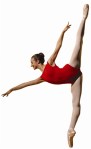
In addition to the usual black, this leo is available in seven colors, including rich shades like plum, wine and navy, in addition to a lovely sky-blue called porcelain. I would pair this cut with simple, classic pink tights – the cut and details show best without a skirt or warm-ups to distract from them.

The Right Leo Size, Every Time!

As much fun as dancewear shopping can be, it can also be frustrating. There is a surprising amount of variation across brands. Pulling a bunch of leos on and off to see what flatters is trouble enough without the added complication of figuring out how the different brands are designed to fit.
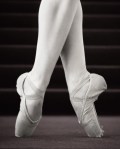
As a dancer with a long torso, I found that taking my measurements and doing a little research on size schemes (and I have done that work for you as you’ll see!) took the hassle right out of dancewear shopping.

When it comes to leotard fit, you will need at least four basic measurements: bust, waist, hips and girth. To measure the first three, align a soft measuring tape parallel to the floor and wrapped snugly – but not too tightly – around the fullest level of your bust, the slimmest portion of your waist, and your hips at the hip bone level.* Wear the least bulky top and bottom possible (but nothing so tight it will change your natural size) and make sure you are standing in proper ballet posture with shoulders down and a square alignment for the truest measurements possible. Use a mirror to make sure the tape is wrapped properly for each measure.

Now for the research – which as I mentioned I have done for you! I have created a chart of all the major manufacturers’ ladies’ sizing guidelines for all brands that use a S/M/L sizing structure. (So no Sansha or Grishko, sorry!) You can download it by clicking here: BalletScoop Adult Ladies Sizing Guide. Once you have your measurements taken and written out, you can easily compare them to the chart and circle what size in each brand will suit you best. Voilà – sizing guesswork gone!!

*For pants, shorts and unitards, the hips will often need to be measured at their absolute fullest circumference, usually an inch or two below the hip bones. The waist measurement for pants should be taken at the level where the waist of the pants are expected to hit – that’s usually an inch or two below your actual waist.

Update: If you had trouble printing this size guide earlier, sorry! It is now on letter-sized paper, so should be easy printing now!

Spendin’ Cheese: Affording Your Passion for Dance

Unless you’re regularly receiving full scholarships for your dance tuition and sponsorships for your dance gear and other expenses, you may have heard your parents grumble more than once about the high cost of paying for your ballet (or jazz, or contemporary …). There are lessons, shoes, practice clothes, travel expenses, costumes and many other items to pay for in order to keep you in training.

First, the bad news: Your parents are right to question the worth of your many dance-related expenses. Don’t underestimate how burdensome it can be to support this kind of training on an average family’s salary. Good dance training and supplies cost serious money – often thousands and thousands of dollars each year. A proper dance education is a financial extravagance, and raising a family is financially challenging enough without this additional expense.

Some dancers are fortunate to have parents that can – and zestfully do – contribute to their talented offsprings’ pursuits, but more than half of the aspiring dancers I have known came from average financial backgrounds. So how can you make it all work? What do you do if your parents threaten to stop paying for your training?

There is some good news…

YOU can help.

That’s right, you probably have a lot more influence over this situation than you might think. There is a way that you can ease the financial burden, impress your parents with your dedication to your dancing and encourage them to contribute to your training. How you ask? By working!

Ok, ok, don’t click away just yet. Working doesn’t have to mean slaving away at American Eagle for a few bucks an hour. Though that is certainly an option! (Ah, the zen of folding a gazillion skinny jeans into neat stacks.) As a young dancer, I had a few sponsorships and scholarships, but I paid for a lot of my own training and gear as teenager with money I earned babysitting, teaching the children’s classes at my studio and even cleaning houses.

You don’t need three jobs on top of school and dance to impress your parents and be helpful though! Consider taking two babysitting jobs a week. If you charge $8 per hour, you could easily make over $100 per month. Agree with your parents that if they will pay for your tuition, you will pay for your dancewear, shoes and costumes – but you have to stick to the deal. Make sure you can pay for necessities like pointe shoes first and save up for any extra training programs and travel expenses before buying fun leotards and warm-ups.

If you can’t bring yourself to start working or to use your hard earned dollars to help your family with your dance expenses, it might be time to reevaluate whether dance is truly your passion or just a pursuit. If you enjoy it immensely but decide that you don’t want it enough to make sacrifices like this, you might find that you are happier just taking a weekly class for fun instead of a daily schedule. And that’s worth knowing for your own sanity’s sake! If it is your passion, you will probably find that you feel motivated to contribute and excited to be able to start taking charge of your own dance training.

As a final note: Money is very tight for a lot of people these days. My heart goes out to you if your family is dealing with a loss of employment or other financial hardship. There are undoubtedly situations where young dancers in this economy simply will not be able to continue to train regardless of how much they are able to help out. If this is your situation, know that there is a world of dance waiting for you when you are all grown up and on your own. There is a whole universe of people who started or continued dance after high school due to issues like this, and many of them love and enjoy taking class much, much more than they ever would otherwise.