Here are some lovely art photographs of a ballet student from North Carolina. Perhaps under Ethan Stiefel with NCSA?
Tag: pointe shoes
Dancewear en l’air: The Twist-Back Tank
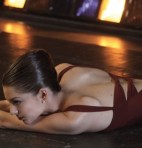 From the French brand Wear Moi, here is a wearable piece of art for your next class or audition. Wear Moi’s Isaline leo brings attention to your back with two lateral knotted strips of tulle to match the stretch tulle front and straps.
This leotard comes in four lovely shades, but its drama seems best suited to the rich maroon or ink black versions. Isaline would pair nicely with a simple black roll-waist knit tight or a matching skirt that won’t take steal attention away from its über-refined and understated details.
Ballerina Project (via A Slice of Lemmons)
How about some simply gorgeous photos to inspire you before your next ballet class? Enjoy!

Dancewear en l’air: The Sporty Zipper Unitard
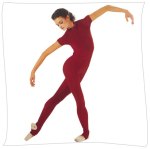 Unitards can be fun for rehearsals and even auditions, especially for contemporary ballet, and Sansha’s mock-neck unitard #503 is a modern change from the usual unembellished tank and long-sleeved versions.
This unitard features a zipper from the neck to right below the bust so you can customize your look. Stirrups at the feet keep the leg lines as long as possible and accentuate pointe shoes particularly well.
Dancewear en l’air: The Backseamed Pink Tight
 Ballet tights in an unflattering shade of pink are one of the CBT’s pet peeves! Choosing a pink that clashes with your pointe shoes or ballet shoes will shorten your lines and just look wrong.
Pinks can vary depending on the amount of blue and yellow in the dye formula. Generally, classical or ballet pink tights look best with the more salmon-y shoes, like Freeds and Capezios, while theatrical pink looks better with truer pinks and paler shoes, like Grishkos and Russian Pointes. You may need to purchase one shade to match your soft shoes and one for pointe.
Non-mesh tights are usually very soft and appear to be a pretty pale pink in the package, but they often look white, yellow or purple once their on. Mesh tights can be almost scratchy sometimes, but usually have better pinks. (Steer clear of Capezio #9 in classical pink, though, it’s famous among dancers for looking bright orange!) A backseam makes alignment checks easier and visually lengthens your lines dramatically.
One of the best ballet tights on the market currently is the Body Wrappers A45, a convertible mesh version with a backseam available in ballet pink and theatrical pink. Its designed to feel super soft against the skin so you’ll get the best of both fabric worlds, and you’ll look polished and professional.
10 Pointe Shoe “Don’ts”
 Fall is nearly here, and with it a brand new crop of beginner pointe students. Are you ready for pointe classes? Perhaps you have scheduled a fitting or are just waiting for shoe-approval from your teacher. Maybe you already sat down with a parent or an older student to learn how to sew your shoes. Or maybe you are even entering your second or third year of pointe.
The CBT sees a lot of mistakes from pointe students in their first few years. Its to be expected, but if you want to jump the learning curve a bit, there are some pointers that can save you time, frustration and embarrassment. So with that in mind …
- DON’T rely on your parents. As you may have gathered from the above and prior posts, students should start taking care of their own gear and hair for class sooner rather than later. Having your parents take care of these things implies to your teacher that you are probably too immature to handle really advanced training.
- DON’T try to cheat in your sewing with Pointe Snaps or any other such horrid invention. Not only do they totally not work, they stomp all over the traditions of ballet.
- DON’T use Knot Keepers or tape to keep your knots in place. By all means, be concerned if your ribbons come out of hiding -Professional contracts used to include monetary fines for dancers that had this happen. But don’t ruin the look of your shoes by cheating with these things. Just learn to tie them properly.
- DON’T use rosin on your shoes if you have a marley floor. Here’s where innovation is a good thing. Rosin was used by dancers back when ballet floors were made of wood. It made the shoes slightly tacky to give greater connection and feel for the floor. Marley’s special makeup eliminates the need for rosin, and rosin can actually damage a marley floor.
- DON’T force yourself to deal with loose lambs wool or paper towels as your beginner toe padding. Those things are just far too much trouble for even the most advanced dancers these days. Again, the quality innovation and technology in this area is worth taking advantage of.
- DON’T overpad your toes. This is a super common beginner mistake. Overpadding prevents you from feeling the floor and pointing your foot properly, which makes the feet look like floppy fish and ruins your lines! Pad within reason, and as your feet become used to pointe shoes, periodically try to scale back your padding by going to a smaller pad or by removing them in favor of spot-padding.
- DON’T be afraid to try different shoes for a while. It can take quite some time to find the shoe that fits you best. You’ll probably get a perfectly decent pair the first few times, but its worth it to keep trying different things to find your most perfect match. You have to be prepared to learn the balance point in each new shoe you try, however.
- DON’T practice center exercises at home. At least, not unless you like taking off from dancing for six weeks because you sprained your ankle trying to do a piqué arabesque in your kitchen…
- DON’T expect too much too fast. Pointe training has to be done gently and carefully in order to reach the desired result. Every pointe student has had to go through the on-two-feet-facing-the-barre stage. You will be beyond that before you know it and glad you put in the time.
- DON’T forget to be proud of yourself for all the hard work you’ve put in and for everything you have achieved.
Get The Goods
When I was a young dancer, Discount Dance Supply was best mail-order company for dancewear. (No internet back then, kiddos!) They would special order styles, colors or sizes that didn’t appear in their catalog. Though they are still pretty good, they no longer provide special order service – If you want a special size or item you’ll have to look elsewhere.
Many excellent dancewear retailers have a wider selection and better service than DDS. If you still can’t find what you want, quite of few of them will special order, cut-to-order or dye-to-order your item. Some do not show up easily in Google though, so you kinda have to know where to look. Lucky for you, the CBT is in the know! Here’s the 411 on the best places to get the goods:
ADA Discount Dancewear
http://www.adadance.com
All 4 Dance
http://www.all4dance.com/
Amazon.com (For real – Just search for what you want in sports apparel!)
http://www.amazon.com/
Back Bay Dancewear
http://www.backbaydancewear.com/
Capezio Dancewear Shop
http://www.pagelinx.com/cpzo/
Dance Distributors
http://www.dancedistributors.com/
Dance Express
http://www.dancex.com/
The Dancer’s Shop
http://www.thedancersshop.com/
Dancer’s Warehouse
http://www.dancerswarehouse.com/
DWC Dancewear Corner
http://www.dancewearcorner.com/
Just For Kix
http://www.justforkix.com/
New York Dancewear
http://www.nydancewear.com
River’s Edge Dancewear
http://www.riversedgedancewear.com/
Tutu.com
http://tutu.com/
I have not included here the it-sites for costumes or for designer dancewear manufacturers who direct-sell on their site, but I’ll make separate posts for that eventually. Send me a message on the Contact the CBT page if you want to see that info sooner rather than later. Happy Shopping!
Ballet in Film: Ballerina
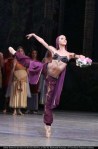 One my absolute favorite dance documentaries, Ballerina, is now available to watch instantly on Netflix. This exquisite portrait of five female ballet dancers from the legendary Kirov is a relatively recent film, which lends it a much more modern air than most dance documentaries available, particularly when it comes to the level of virtouosity of the dancing itself. If you are looking for true inspiration and to see just how elevated a level ballet can reach, I highly recommended you check it out.
When Can I Go on Pointe, CBT?
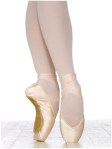 Every beginning female ballet dancer dreams of going on pointe, but that dreamy day can and will be ruined by pain and injury if you are not prepared. I don’t want to scare you but I have witnessed the pain and frustration of an ill-prepared beginner pointe student! It is far more difficult to overcome poor pointe technique resulting from ill-preparedness than to simply wait until the dancer’s strength and technique are ready.
It is your ballet teacher’s job to know from experience and education when his or her students are ready, but surprisingly few ballet teachers actually share that information with their students. There can be many reasons for this. Some teachers are concerned that if they explain the details of why, students and parents will be encouraged to argue about whether their daughter fits the parameters. Other teachers like to encourage a certain mystique about the whole affair (though they’d never admit this), thus generating further suspense and excitement for the students and parents and securing the teacher’s perceived status as a guru of super secret sacred ballet info.
I do not subscribe to either of these philosophies. In fact, I believe that transparency in these matters is vital for the dancer’s education! It is with that in mind that I share with you my guidelines for pointe preparedness. Mind you, these are not hard and fast rules, and it does take the teacher’s expertise to know if the dancer has actually met a given requirement. So without further ado:
- A student must be 11 years minimum to allow proper bone ossification. When children are young, the growth plates are soft, and repetition of improper technique in something as strenuous as pointe can deform the feet and body in short order. It is common for dancers to have to wait until they are 12 or older so their technique and bones can strengthen.
- A student must have at least 2 consecutive years of quality training immediately prior to promotion. Length of training is not an estimation of pointe readiness, however.
- A student must be in good health and able to take a whole class. This includes being of healthy weight. If the student frequently needs to rest because of illness or injury, she is not strong enough for the extra demands of pointe work.
- A student must consistently take a minimum of two classical ballet technique classes a week. Daily class is preferred and necessary for students training for ballet as a profession. Class frequency makes a significant difference in development.
- A student must pay attention in class and work well. Going on pointe is a big step and requires commitment on the part of the student.
- A student must be responsible enough to bring all the gear she will need to class. Pointe shoes require extra care and accessories.
- A student must habitually use her core muscles properly and have a strong, proper posture while dancing and standing. Pointe requires that the student use the muscles in her torso, legs and feet to stand en pointe and not use the shoes as a crutch. Core weakness will throw the student off balance and will make it difficult to dance.
- A student must use correct plié while dancing and exhibit supple calf and leg muscles.
- A student must hold turnout from the hip while dancing. Turnout makes it possible to do steps that could not otherwise be done. If the student does not maintain their turnout, they are not strong enough for pointe.
- A student must keep the heels forward. (No sickling, a sure sign of improper technique.) The most stable position for pointe work is to have the weight slightly forward between the big and second toes. Improper center will make it more difficult to stay en pointe, and will increase the chances of strain and injury.
- A student must point the whole foot from the ankle and instep with toes pointed but long while dancing. These muscles need to be strong enough to support the body weight. If the student is not in the habit of articulating the foot muscles properly, they will not be able to support themselves en pointe.
- A student must have enough of an arched instep to stand on pointe. Dancers with very high arches often have weak alignment or weak muscles that they must first master.
- A student must execute properly 16 relevés in the center without stopping and 8 at the barre on one leg without stopping, right and left. There should be no pumping action through the upper body during this execution. Strength for pointe work is achieved by repeating exercises. Relevés are excellent for building calf and leg strength, which is vital for pointe. If foot and leg strength is an issue, Theraband exercises can improve this deficiency.
- A student must pique passé/retiré with straight leg and proper alignment. Student should have enough strength to push themselves onto half-pointe. This step is harder to do en pointe and a bent leg is a sign of weakness or improper step preparation.
- A student must hold a retiré balance on half-pointe. The student should be well-placed (hips square, back straight, legs turned-out), and have the strength to balance on half-pointe. This pose is more difficult to correct en pointe, as the surface area for balancing is smaller and the turnout strength requirements are greater.
Most syllabi dictate that working properly in ballet class is sufficient preparation for pointework. As mentioned above, special exercises may be prescribed to help the dancer who is behind her classmates. Some schools devote whole classes to this preparation, called Pre-Pointe. There are varying philosophies on its appropriateness – but that is a topic for another day!
 BalletScoop