If you are getting ready to take ballet for the first time, you might want a heads up on what to expect, from what the barre is really for to what the teachers expect from you.
When you arrive, find out where to put your dance bag and purse. If you need to change, find out where dressing or restrooms are available. You should be in your dancewear with hair pulled back and completely ready to walk into class five minutes before the start time.
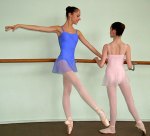
Exercises in ballet follow a certain general order. The class is begun at the barre, which you are probably familiar with from movies and TV as a railing that is used by dancers for warm-up. The barre is intended to be a light support. You should always practice at the barre as if you will eventually perform the exercises without it – because you will! Hanging on the barre or gripping it are huge no-nos.
When you walk into class, the first thing to do is introduce yourself to the teacher. Even if you met her during your enrollment, it is helpful for her if you re-introduce yourself.
Next, find a spot at the barre about four to five feet away from anyone else so that you can perform your exercises without kicking or bumping someone else accidentally. There’s definitely an unspoken rule about who gets what spot at the barre. Students who have some seniority usually have favorite spots that are considered theirs. Wait a few seconds before choosing your spot so you can avoid “stealing” one from one of these students.
If it’s the first day of class for a number of students or if it’s the first day of the year, the teacher might go over some class rules. In case she doesn’t though, here’s the basic rundown of what’s expected:
- When you are in the studio, speak only when prompted or raise your hand when you have a question, even if class is over or hasn’t yet begun.
- Ask for permission to leave the room or leave early, and ask in advance if at all possible. Never arrive late. If you absolutely must, enter the room as quietly as possible. Do not enter or exit the studio during a combination.
- Adhere to the dress code. Be neat and clean. Do not wear ill-fitting items or those in disrepair.
- At the barre and in the center, do not get so close to others that you kick or bump into them.
- Do not compare yourself to others. Work towards your personal best.
- Do not leave the room without a thank you, small curtsy or both to the teacher and accompanist. (This is very dependant on culture. Watch the other students.)
- No gum chewing.
- No jewelry.
- Water is the only drink allowed in class.
- You are responsible for reading notices, cast lists and keeping track of important dates and events.
The barre exercises will begin with knee-bends and extensions of the leg away from the body. At first, your toes will stay touching the floor, but as the exercises progress, the leg will be extended off the floor in increasing heights. You might also practice balancing on two legs and eventually on one.
After the barre exercises, students work on center practice. As a beginner, these exercises will be similar to the work performed at the barre and may also include small jumps. As you progress, turns will be added and jumps will increase in height and complexity.
Throughout the exercises, the teacher may call out corrections to the class. You are expected to listen and apply them. She may also direct her attention to an individual student and might use her hands to physically move the student’s body into the shape that’s needed. If you are that student, don’t get anxious. Just listen and try to put into practice what she is asking. If its your first day, this might happen quite a bit as the teacher works to get you to understand the steps.
For the last exercise, the teacher might guide the students through a slow bow or curtsy combination called reverance. Once class is over, all students should clap for the teacher as a thank you. They may also then thank the teacher individually with a curtsy. Watch the other students in the class and follow their lead on this. Some teachers do not prefer an individual curtsy and thank you because they need to get to another class and move on with the day.
Don’t be concerned at all if you did not understand a lot of the words used for the steps or if you were limited in what you could do. If you keep going to class, that will change quickly. This is my final post in this three-part series – All that is left is for you to go and take that first class!
Congratulations on trying something new and entering the beautiful world of strength and creativity that is ballet. Enjoy it and good luck!
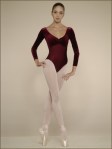 Ok, so winter isn’t exactly here yet, but it will be soon! What better way to stay warm when the chilly days come than with a luxiouriously velvety velour long-sleeved leo, like Grishko’s
  If you are getting to an advanced stage in your training, chances are you have already worn or will soon wear a tutu. I’m not talking about those mass-made recital costumes that arrive crumpled up in plastic bags – I’m talking about a fully or partially handmade tutu carefully constructed with hoops, high-quality tulle and a corset-style basque and bodice. (Insert high-pitched squeal of girly joy!)
 Flaunt Bodywear’s teardrop leotard
  In classic Balanchine style, this tank dress from Body Wrappers has clean lines and minimal fuss. The back is not too high or too low, and the attached skirt is just the right length for class or performance. Even the model here is sporting a Balanchine-esque pose.
 Studying a Giselle variation this year? You’ll look ready for the title role in this lovely peasant-top style,
  Nothing beats gorgeously simple Italian design, and here to prove it is Deha with model No.
 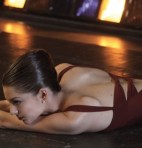 From the French brand Wear Moi, here is a wearable piece of art for your next class or audition. Wear Moi’s
 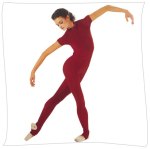 Unitards can be fun for rehearsals and even auditions, especially for contemporary ballet, and Sansha’s mock-neck unitard
  Camisole leotards are the most popular leotards on the market, which is why there are so many available – good, bad and ugly. But when you’re searching for a classic, picture-perfect camisole that will flatter every shape, look no further than Mirella’s
 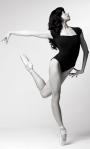 Looking for a leotard that covers without looking dowdy? The
  Anyone who’s taken pas de deux class while wearing a wrap skirt knows what an annoyance those ties can be in the middle of supported pirouettes or allegro work. Skirts can be fun to wear and can accent your movement nicely, but in partnering class they can be a distraction or irritation to you and your partner. Time for a one-piece dance dress, like Degas’s delicately refined
  If you are looking for a fun leo that will transition you from ballet classes to jazz classes in style, check out Yumiko Dancewear’s
  BalletScoop