Dancewear en l’air: The Diamond Leotard

This thoughtfully cut leo features criss-crossing panels of fabric that narrow towards the hips making a flattering hourglass effect and creating a small diamond in the center bust. The criss-cross pieces wrap low around the back of the leotard creating a cute hip-skimming accent.

I hesitated to feature this interestingly cut leotard because, since Bloch’s recent purchase of Mirella, not all of their leotards are featured on either site. This particular leo is tough to find anywhere, but if you know the model number (MJ7115) you can find it in online discount stores, particularly if you’re willing to order from the UK. It’s available in a slate-like indigo, true red and classic black.

The 360 design of this leotard is what makes it so gorgeous. I’d pair it legwarmers or just pink tights so as not to obsure its pretty and flattering shape.

Dancewear en l’air: The Flashdance Top

An 80’s retro top is perfect for dance inspiration, and K.D. Dance FAL1143034 captures the era perfectly with its drapey style. This Flashdance-inspired top is cut oversized (but is also available in a more close-cut fit) and comes complete with the original’s signature off-the-shoulder neckline that casually shows off your collarbone.

Created from K.D. Dance’s beautiful shadow stripe acrylic blend fabric, this sweater is available in some basic shades as well as an assortment of rich purples and wines. Lovely for a ballet warm-up or just to and from class, this is also a great piece for modern, contemporary and jazz classes. What a feeling!

Dancewear en l’air: The Vibrant Wrap Skirt

Let’s beat those Monday blues with some fashion today. If you’re in the mood for a stylistic pick-me-up, Capezio’s 1290, a printed chiffon wrap skirt, is just the thing for your next class.

I really like the length of this skirt for pointe classes in particular – the gently tapered hem gives a nice length to the leg without looking – ahem – “hoochie” short.  And the floral pattern of teal, burgundy, pink and black will pair nicely with a basic black or with your bolder leos in similar hues.  I think it would look great over a unitard, too. All in all, an elegant but very fun pick.

Dancewear en l’air: The Tiger Leotard

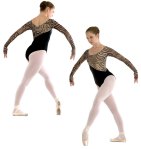
This leo is so outrageous I just had to feature it for fun today! The Tiger Leotard (scroll down on their long-sleeve leos page to find it) by London-based Wear Moi International – not to be confused with French dancewear company Wear Moi – makes this arresting tiger stripe ballet leotard, which seems reminiscent to me of Oleg Vinogradov’s Knight in a Tiger’s Skin ballet from the Kirov!

Like many of Wear Moi’s leos, this item is created in two different fabrics, in this case a black lycra bottom and the striking tiger print on top. An asymetrical seam connecting the two and extra-long sleeves set off the tiger print with a haphazard and exotic vibe. This style is not for the faint of heart!

Dancewear en l’air: The New Princess-Seamed Camisole

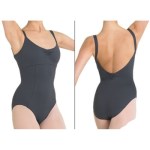
Sleek and sophisticated is what I think when I look at the construction of Bloch’s L2750. This style gives homage to classic shape through flattering empire and princess seams, but brings it to 2010 with updated fabric and a modern cool-toned Steel version. The straps are camisole style, but not too thin that they’ll dig into your shoulders.

This piece is great for class, rehearsal or even a leotard performance. Just add dance shoes.

Fits Like a Glove – For Your Foot! – Part 2

Once you’ve found the best pointe shoe combinations of box, width, vamp and shank, try the remaining shoe or shoes with cushioning. I do not recommend loose lambs wool, paper towels or newspaper. There are so many much better options available these days!

Cushions should enhance comfort and fine-tune the fit; they should not be used to compensate for a sloppy fit! Use as little cushioning as possible. Many dancers who wear no pads find they need at least one of the oval or mushroom cushions. If these are not sufficient, use additional cushions. It is also possible that a narrower box or a box liner is needed to prevent the foot from dropping in too much. If the length and width are correct but there is pain or pressure on the toe(s), more cushions may be needed. Here are some options: Continue reading

Fits Like a Glove – For Your Foot! – Part 1

There is more to fitting a pointe shoe than finding the right shape, though shape is integral. Each part of the shoe should be checked and the overall fit should exhibit certain characteristics. How do you check for these things? How do you start the fitting once you’ve chosen shoes based on shape?

First off, you need to get the correct size for the brands you are going to try. The best way to do this is to have your foot measured on a Brannock device. Stand with one foot on the device with the heel all the way against the back, and make sure the feet are parallel. Measure with the weight completely on the foot being measured. Find the appropriate width and arch length. Next, measure with the weight off the foot being measured and note change in width. (This is how you measure metatarsal compression.) Measure both right and left feet because their may be a difference. Now, put on the first pointe shoe you want to try on.

Be sure toenails are neatly trimmed and the drawstring is properly pulled and secured. Standing flat, pull slowly and carefully criss-crossing the ends parallel to the floor, not upward toward the knee. When pulling the drawstring, be sure both ends are completely free and that there are no knots. Always pull both ends evenly, so that you don’t lose one end inside the binding. The drawstring should feel snug, not tight, to avoid irritating the Achilles tendon. Tie securely. Stand in second position and grand plié. This will put the foot in its longest position. The toes should just barely touch the end of the box, without feeling crunched or smashed.

Set a foot en pointe with no weight on it. You should be able to pinch 1/4” to 1/2” at the top of the heel near the drawstring casing to ensure that there is enough room for the toes when rolling up through pointe and when standing flat. If you can fit a whole finger in the back of the shoe it is too long. If you cannot pinch any material it is too short.

Many dancers are fitted in shoes that are too short, and compensate for the discomfort by increasing the width. A foot that is a true wide is the exception. Shoes that are too short and wide cause great pain. Dancers will do almost anything to alleviate it, including wearing padding that only exacerbates the problem. If a dancer has enough room for bulky pads, the shoe is not properly supporting the sides of the feet.

Now that you have the correct size in the shoes you are trying on, you will need to check the fitting for proper width, box, vamp and shank.

For the box and width: Focus on how your toes and the ball of your foot feel. Are toes held tightly together (no wiggle room) without being pushed on top of each other? With a perfect fit, the edge of the hard part of the box does not show through the satin. The shoe should be snug enough that you can barely slide a finger into the shoe a bit at the top of the foot. If you can fit a finger easily in the throat or sides of the shoe it is too wide or the box is too big. The foot should fit snugly against the top of the shoe. Additionally, the strengthened wing of the shoe should be high enough to just cover the big toe joint, while not restricting demi-pointe.

The compressible foot should be fitted carefully and might need a narrow box or a boxliner. Pointe shoes must not be too narrow. Allow enough width for demi-pointe. If a shoe is too tight, the metatarsals and toes may be constricted and unable to move properly. This can compromise fine control of the forefoot. The front of the shoe should be sleek and snug, but not so tight that bunions bulge or the edge of the box digs into the bunion from underneath it. Shoes that are too wide are unsupportive and can cause great pain. Too tight shoes or shoes or those that are too tapered can promote bunions and cut off circulation.

Next, check the vamp and the strength of the shank: When on pointe, the foot should be over the platform, not held back, over too far, sinking in the box or popping out of the box. In general, short toes want short vamps, long toes want long vamps. The vamp should be long enough to keep the dancer from popping out of the shoe, but short enough to not restrict demi-pointe.

A less flexible ankle is often helped by a shorter vamp, but make sure knuckles and bunions are totally covered. Dancers who go over too far despite deep vamps and straight, stiff shanks should try vamp elastic. If the shank twists noticeably away from the sole of the foot, check the dancer’s alignment and be sure the shoe is not too narrow.

In general, the lighter and more flexible the shank, the easier it is to roll through demi-pointe and to get over the platform. Flexible shanks allow a dancer to achieve a higher demi-pointe before attaining full pointe, and they readily conform to the foot. They are beneficial for less flexible ankles. Professionals often prefer softer shanks because they can better control their shoes.

Firmer shanks may be necessary to prevent a dancer from going over too far, which can overstretch the ankle and hinder placement. Harder shanks are required by dancers with highly arched feet and by those who are tall and big-boned, but they give more resistance in rolling through demi-pointe.

(¾ shanks should never be used to help a dancer get over. Doing so will cause the dancer to sit on the shortened shank and encourage Achilles tendinitis due to the clenched tendon trying to hold the foot in the en pointe position improperly. Sitting is the danger for those new to pointe, because if they are not taught to pull up out of their shoes, they will sit in them. While you can sit in any pointe shoe, ¾ shanks make it easier for lesser experienced dancers to sit in their shoes. I do not allow beginner pointe students to wear ¾ shanks!)

In part two of this article, we’ll finish up this fitting and talk about toe pads.

Dancewear en l’air: The Corset-Style Camisole

This striking two-tone leotard, 107-ROY from By Marisa, flatteringly mimics of the bodice of a tutu. What makes this item special is the contrasting black trunk and trimming combined with corset-style seaming on the bodice.

This isn’t an item that you want to cover up with a skirt or sweater – add it only to your favorite pink tights to avoid an overly busy look and just let the leotard’s lines accent your own. This leotard is also available with a white or red top by different model numbers.

Dancewear en l’air: The Knit Bolero Shrug

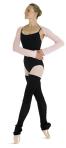
Looking for a warm-up top that won’t hide your beautiful leo? A bolero-length shrug is your answer. Lydia, by Bloch, is a beautiful and well-made option in Bloch’s signature cashmere-like knit blend.
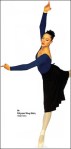
This long sleeve top features ribbing detail at the cuffs and covers you from shoulders to wrists in one of four classic colors. Accessorize with legwarmers or a pretty chiffon wrap skirt to balance this look.

Dancewear en l’air: The Figure-Flattering Character Skirt

Impossible you say? How can a frumpy character skirt possibly flatter your figure? When its a sleek and not ridiculously long wrap style. Thanks to Bal-Togs, you have just such an option with 86, available through On Stage Dancewear.
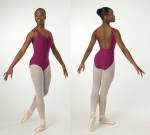
This style is conveniently available in multiple lengths. I think character skirts look best when they just cover the knee – anything longer is too cumbersome and mature looking. You can’t play the part of a young European peasant if you look like an elderly marm! Also, the wrap cut of this skirt eliminates the frumpy, schlumpy gathers that the elastic-waist versions often have and which can add unattractive volume to the hips. Just make sure a wrap style is allowed in your character class, and then get ready to mazurka!

Dancewear en l’air: The Low Square-Back Tank

Prima Soft came up with a beautiful square cut for the back of its leotards a few years ago, and its still gorgeously flattering today. This angular, low cut on a classic tank style, 501, keeps the leo from looking too much like a swimsuit, which is sometimes how a tank leo looks with a low scoop back. The pinched front of this leo is equally flattering.

The versatility of this tank is great. It would look equally beautiful with a wrap skirt or without. Clean lines, classic styling and traditional colors make it ideal for even fairly strict dress codes.

Dancewear en l’air: The Two-Tone Practice Tutu

In my recent post on the tutus, I featured this lovely rehearsal piece, C705, by Primadonna Tutus as the example. But such a well-made and economical piece really deserves it’s own post.

This practice tutu comes in classic white tulle. The black and white basque mimics the pointed basque-waist of a performance tutu’s architecture when worn with a black leotard as shown. This is a gorgeous rehearsal piece, but if you are looking to dress it up for a competition or recital, be forewarned that the two-tone feature doesn’t really lend itself to evolution into anything else. Primadonna offers all-white and all-black options if you need that versatility.

The price is nice on this piece and options include a 12″ or 14″ skirt, a hoop on request for $20 more, and either eight or ten layers of tulle. All told, you’ll probably won’t even reach $200 for the most expensive version.

Ballet for the Teen Beginner – Part 3

If you are getting ready to take ballet for the first time, you might want a heads up on what to expect, from what the barre is really for to what the teachers expect from you.

When you arrive, find out where to put your dance bag and purse. If you need to change, find out where dressing or restrooms are available. You should be in your dancewear with hair pulled back and completely ready to walk into class five minutes before the start time.

Exercises in ballet follow a certain general order. The class is begun at the barre, which you are probably familiar with from movies and TV as a railing that is used by dancers for warm-up. The barre is intended to be a light support. You should always practice at the barre as if you will eventually perform the exercises without it – because you will! Hanging on the barre or gripping it are huge no-nos.

When you walk into class, the first thing to do is introduce yourself to the teacher. Even if you met her during your enrollment, it is helpful for her if you re-introduce yourself.

Next, find a spot at the barre about four to five feet away from anyone else so that you can perform your exercises without kicking or bumping someone else accidentally. There’s definitely an unspoken rule about who gets what spot at the barre. Students who have some seniority usually have favorite spots that are considered theirs. Wait a few seconds before choosing your spot so you can avoid “stealing” one from one of these students.

If it’s the first day of class for a number of students or if it’s the first day of the year, the teacher might go over some class rules. In case she doesn’t though, here’s the basic rundown of what’s expected:

  1. When you are in the studio, speak only when prompted or raise your hand when you have a question, even if class is over or hasn’t yet begun.
  2. Ask for permission to leave the room or leave early, and ask in advance if at all possible. Never arrive late. If you absolutely must, enter the room as quietly as possible. Do not enter or exit the studio during a combination.
  3. Adhere to the dress code. Be neat and clean. Do not wear ill-fitting items or those in disrepair.
  4. At the barre and in the center, do not get so close to others that you kick or bump into them.
  5. Do not compare yourself to others. Work towards your personal best.
  6. Do not leave the room without a thank you, small curtsy or both to the teacher and accompanist. (This is very dependant on culture. Watch the other students.)
  7. No gum chewing.
  8. No jewelry.
  9. Water is the only drink allowed in class.
  10. You are responsible for reading notices, cast lists and keeping track of important dates and events.

The barre exercises will begin with knee-bends and extensions of the leg away from the body. At first, your toes will stay touching the floor, but as the exercises progress, the leg will be extended off the floor in increasing heights. You might also practice balancing on two legs and eventually on one.

After the barre exercises, students work on center practice. As a beginner, these exercises will be similar to the work performed at the barre and may also include small jumps. As you progress, turns will be added and jumps will increase in height and complexity.

Throughout the exercises, the teacher may call out corrections to the class. You are expected to listen and apply them. She may also direct her attention to an individual student and might use her hands to physically move the student’s body into the shape that’s needed. If you are that student, don’t get anxious. Just listen and try to put into practice what she is asking. If its your first day, this might happen quite a bit as the teacher works to get you to understand the steps.

For the last exercise, the teacher might guide the students through a slow bow or curtsy combination called reverance. Once class is over, all students should clap for the teacher as a thank you. They may also then thank the teacher individually with a curtsy. Watch the other students in the class and follow their lead on this. Some teachers do not prefer an individual curtsy and thank you because they need to get to another class and move on with the day.

Don’t be concerned at all if you did not understand a lot of the words used for the steps or if you were limited in what you could do. If you keep going to class, that will change quickly. This is my final post in this three-part series – All that is left is for you to go and take that first class!

Congratulations on trying something new and entering the beautiful world of strength and creativity that is ballet. Enjoy it and good luck!