Ballet for the Teen Beginner – Part 2

You have selected a dance school and signed up for ballet lessons. Now its time to shop for your ballet clothes!

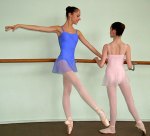
Your dance school should provide you with a dress code and a list of stores to purchase the items you need. Don’t go online to buy your first ballet clothes – you will need to try things on and get help selecting styles and sizes. You will need at least one basic leotard, a pair of pink tights, and a pair of pink ballet shoes. If you will be taking more than one class weekly, you may need another set or two of tights and a leotard. Depending on the dress code, you may also wish to purchase a basic short wrap skirt and some simple warm-ups or cover-ups for walking in the halls between classes or for warming up before class. So let’s talk about what to shop for.

Before we get started, be forewarned that you may feel a bit strange in a leotard and tights at first. They look and feel very different than street clothes! A question that new female dancers are often too shy to ask is: Should I wear underwear and a bra under a leotard and tights? Most dancers consider the tights to be the underwear and most leotards are made with a lining or shelf bra attached. (Wearing dancewear is very similar to wearing a bathing suit.) If you are not comfortable with this and prefer additional layers, there are many options available specifically for dance that you may choose from. Body Wrappers, Natalie and Capezio offer boyshorts, thongs, bikini cuts, bra tops, leotard-cut underliners and unitard-cut underlines. These are all designed in fabrics and colors that fit discreetly under leotards or costumes and that are moisture-wicking. Do yourself a favor and don’t try to wear streetwear underclothes with your dancewear. Street styles are way too bulky and noticeable, and they can trap moisture and heat that can cause, ahem, issues.

Now for the fun stuff. For your first pink tights, ask for a convertible foot. These tights have a slit on the bottom of the foot so they can be rolled up to the ankle. This is invaluable if you are planning to take other dance classes, like modern or jazz. I would recommend choosing Body Wrappers, Capezio, Gaynor Minden or Bloch tights. These brands offer various fabric choices, so ask the sales person to let you feel the different fabrics and help you choose the proper size.

For your ballet leotard, you should choose something simple in a comfortable fabric and cut. A short sleeve or tank version with a high back is usually best for your first leo to avoid feeling too revealed and to be able to wear a bra if you prefer or need to. Some good leotard brands are Mirella, Body Wrappers, Capezio, Bloch, Grishko, Freed, Sansha and Natalie.

Next your pink ballet shoes. Soft ballet shoes are made in satin, leather and canvas. If your dress code does not specify, try leather or canvas which are what most students wear. Ballet shoes should cover the toes, sides of the foot and heel. The sales person should help you find a size that does not bag around your foot but does not cramp your foot either. For advanced students, I like to see elastic criss-crossed from heel to arch, but on a beginner, I recommend just one elastic across the arch of the foot. Ask the sales person if they sell any shoes with elastic pre-sewn. Look for ballet shoe brands like Fuzi, Angelo Luzio, Capezio, Bloch, Sansha, Freed, Grishko and Principal.

Ballet shoes come in split-sole and full-sole. That refers to the leather pad on the bottom of the shoe. A full-sole shoe has a strip of leather in a footprint shape while a split sole has a pad on the ball of the foot and one on the heel. The idea is that a split-sole highlights and enhances the look of the foot’s arch while increasing ease of motion. It does, but note that a full-sole offers resistance on the arch that can be useful for pointe preparation.

Now to accessorize. Does your dress code allow for a short skirt? If so, make sure you know what colors are acceptable and if there is a minimum or maximum length. If the dress code just says “short”, look for a one-layer skirt no shorter than ten inches and no longer than fifteen. Basically, you want a length that covers the bottom of you leotard when you are standing still, maybe an inch or two longer if you like the look. The most common cut of a ballet skirt is a wrap style that you will cross in the front and tie in the back. If you don’t want that hassle, some pull-on styles are available. Look for delicate chiffon, georgette or tulle fabrics that flow when you move and swirl when you twirl!

Now for your warm-ups. Most teachers do not allow warm-ups during class, but they are great for protecting the muscles after class during cool down and between classes. They also protect against cold A/C. Some warm-ups double as cover-ups. Warm-up options are so numerous, I can’t possibly list them all, but some options include legwarmers, wrap tops, shrug tops, tunics, knit tights, warm-up dresses, knit skirts and shoulder wraps. Try on different styles to find what you like best.

At any age, it is really inappropriate to walk to or from the studio in nothing but a leo and tights. You should bring either a change of clothes or cover-up outfit to wear to and from the studio. A simple cotton dress that you can slip over the head works well for this, as does a sweatsuit.

If you have a gym bag, that should be suitable for your ballet gear. If not, you will definitely want to purchase a medium-sized bag that can fit a change of clothes, a water bottle, your purse and your ballet shoes and warm-ups.

Lastly, your hair. Most ballet schools require that females wear their hair pulled up off the face in a bun or french twist. You should can pick up hairpins, elastics, hairnets and anything else you need at a local drugstore or at the store where you purchase your dancewear.

You have everything you need for your first ballet lesson! Be sure to allow enough time before your class to change into your dancewear and style your hair. And get ready to enter an exciting world of art, emotion, strength and unparalleled beauty. In my next post, I’ll tell you what to expect during your first class!

Ballet for the Teen Beginner – Part 1

When is too late to start ballet? What should I look for in a ballet school? Can I become a professional dancer if I start training as a teen? What on earth do I wear?

If you’re a teen that is interested in beginning ballet classes for the first time, these are just a few of the exciting questions you probably have. Ballet is a wonderful activity at any age for strengthening the body, increasing flexibility, emotional expression and spending time with friends. Starting as a teen will give you a different experience than if you start young, but it can certainly be as fun and enjoyable. So let’s get to those questions …

I recommend a physical exam with your doctor before beginning any new physical activity, but it is never too late to begin ballet lessons if you are medically able. Your goals in dance are important to consider though. Do you just want to get some activity into your week while spending time with friends? Do you dream of eventually wearing pointe shoes? Do you aspire to a professional career? Do you just want to try something new?

If your goals are recreational, you have chosen a wonderful activity. Ballet is terrific exercise, is very creative and is great for spending time with friends and making new ones. It’s unlike any other sport because it is also a performing artform. You should plan to take classes once or twice a week to progress at a safe pace recreationally.

If you would also like to one day wear the coveted satin pointe shoes, you may be able to reach this goal. However, this will require a bit more dedication than the above. There are many different factors that go into a student’s preparedness for pointe work, including skeletal structure which cannot be altered. Soft tissue malleability is also an issue. Young children have some ability to change soft tissue range of motion, but that decreases dramatically in the teen years. You will need at least two years of twice weekly lessons before you should be considered for pointe training. Whether you are an acceptable candidate for pointe at that time should be determined by a qualified teacher. But rest assured that ballet is incredibly enjoyable and satisfying activity regardless of whether you are on pointe or not!

Now for the toughest question: Can you become a professional ballerina if you start ballet lessons in your teens? If you are very, very lucky and work very, very hard, yes you can. Just ask Darcy Bussell, Melissa Hayden, Carmen Corella or Misty Copeland. But it would be wrong of me not to tell you that those are extremely rare and fortunate circumstances with dancers that were born with a naturally favorable body and facility for ballet and pointe. If you’ve read my article on becoming a professional dancer, you know just how competitive it is, and that is for students who have been training for nearly all their lives! (Of course, it is different for male ballet dancers, who may be able to start in their mid-teens with no problem.)

Training in ballet as a teen can open doors to other styles of dance that are based on ballet technique. Studying ballet can prepare you for success in modern, jazz, contemporary and other disciplines. Because they don’t require pointe training, these styles can be more accessible to teen beginners for potential of professional dance. Also, even recreational ballet training might lead to new college opportunities.

Once you’ve given some thought to your goals, its time to research local dance schools. The easiest way to come up with a complete list of dance schools in your area is to look on www.yp.com. There are a lot of websites that claim to have dance school listings, but most are dependent on the schools initiating that listing, which many schools don’t. If you are interested in pairing your ballet lessons with classes in other dance forms, focus on studios that offer those other forms of dance in addition to ballet.

Because dance can be harmful if taught improperly, it is important to review the training of each teacher you consider. They should have trained with a school that is well-respected in the dance community at large, not just locally, or they should have had a respectable professional career. Thanks to Google, this shouldn’t be difficult to find out once you have the teacher’s bio. Visit the school to get a feel for its suitability. Do the students conform to a clean and professional-looking dress code? Do the classes seem organized and logically-run? Ask if the studio has sprung floors, which minimize injury. Studios should be large and well-lit with high ceilings and with mirror panels covering at least one wall.

If you have dreams of dancing professionally, your ideal option is to enroll in the recreational division of a professional ballet school (one that is affiliated with professional ballet company) and to try audition into the professional training division once you have reached an acceptable level. You may need to audition even to enter the recreational division. Speak to the teacher or the school directors about your options for entry and progression. You will need to take a minimum of one class a day most days of the week to train at this level. Once you have a learned the basics and strengthened your body, this schedule could need to increase significantly.

Hopefully the schools you look at will offer a teen beginner ballet class. If they do not and you are not comfortable in a class with much younger students, look for an adult beginner class. Do not be discouraged if you cannot find either at a good school in your town. Instead, speak to the teacher or director about how far along you would need to be before you can move into a class with students closer to your age. Create a plan with the teacher or director for reaching your goal so you will not feel like you are stuck in a lower age group indefinitely.

Starting ballet classes can be so exciting. Congratulations on choosing such a beautiful and fun activity. In my next post, I’ll help you prepare for your first ballet classes … with a little shopping!

So you want to dance professionally?

Deciding to pursue a professional dance career is a huge decision. If its something you really want, you will have to have to put maximum effort not only into your training, but into setting yourself up in the best situation to support this goal. With so many factors to address, where should you start?

If you are still a young student, the first item to consider iswhether you are getting the training you need to be technically and artistically competitive. One way to assess your current school is to find out how many of its students have gone on to professional careers and exceptional college dance programs. You should also consider how many hours of training you receive each week and what level of proficiency your teachers each reached before becoming instructors. If you want to dance professionally, you should be training about four hours daily, five days a week, by age thirteen or so. Your teachers should have each either danced professionally or pursued study in pedagogy for their field of dance. Be aware that a former professional dancer may not know how to teach well, and a pedagogically trained teacher may not have enough knowledge about professional-level training.

For ballet, contemporary and modern dancers, finding a school that will put you at your best advantage for a professional career can mean transferring to a school that is attached to a professional company. Many such schools will require an audition for acceptance or at least for level placement. Some of the largest and best of these schools also offer academic classes, like Walnut Hill or the tuition-free Harid Conservatory. Some, like School of American Ballet and Joffrey Ballet School, are affiliated with professional children’s academic schools, and some, like The Rock School for Dance Education, have special arrangements with the local school system. Finding the right school, getting in, and finding a way to afford it can each be huge hurdles.

Some dancers simply do not have support from their family or money to attend or even apply to such prestigious schools, in which case transferring to the best school in your town is the next best option. It is a tougher road but not an impossible one. Before deciding this is your path, research all available scholarships, free-tuition programs and ways to raise funds. Remember that when you start auditioning for work, you will be competing against hundreds of graduates of professional schools like the ones above.

Deciding to transfer out of your current school can be a difficult one. Often a young dancer’s school is like her second home, her dance friends and teachers her second family. Remember that transferring schools doesn’t mean having to cut ties with everyone there, and you should always be respectful and appreciative of the many things your “old” school taught you. A dancer’s first school is usually the one that inspired her to begin a path to a professional career, and that passion for dance is the most invaluable part of a dancer’s education.

You will become eligible for many company auditions by sixteen, but that does not mean you need to start auditioning then. Most companies don’t take dancers until they are in their early twenties at least. Going to a very high-quality college dance program is the step I recommend for professional-track dancers graduating from high school. College dance programs are always evolving in quality, so when its time to start looking at colleges, I highly suggested getting yourself a copy of The Dance Magazine College Guide to find out which ones are best. Ideally, you want to find a truly top program that turns out professional dancers and is affiliated with a professional company so you can gain performing experience and set up a connection to a company while in college. Once again, getting into and affording the right school can be huge hurdles. Scholarships and working while in school can ease the financial burden, but the audition is all you.

About two years before you want to start your professional career, you will need to start intensive research on potential employers and decide on your application presentation. You may have to have to put in as many hours researching companies, developing your marketing materials (résumé, photographs, videos, etc) and earning money to fund an audition tour as you do training – and that’s a lot of hours.

Different companies value different qualities. Preferred body types, training techniques and dancer “looks” can vary widely. You don’t want to waste your time auditioning for a company that only likes lithe blondes with Balanchine training if you are a short redhead trained in Cecchetti. You’ll find that some companies welcome a variety of looks for their dancers, and you may prefer that culture.

Finally, it comes down to the audition. When at all possible, avoid the cattle calls of open auditions. It can be extremely difficult to find work this way. Instead, find out how to get into a company class. Some companies will want to see your video before they will agree to let you audition. Those pre-screened auditions are also much better than the cattle calls. If you are offered contracts, you will need to compare your potential pay and benefits, geographic locations, amenities, facilities,  performance opportunities, etc, to decide which offer you want to accept.

There is so much more to this process than I’ve laid out here, and I’ll try to address specific items in more depth in later posts. But hopefully this has given you the basic idea of what it really means to say, “I want to dance professionally!”

Dancewear en l’air: The Backseamed Pink Tight

Ballet tights in an unflattering shade of pink are one of the CBT’s pet peeves! Choosing a pink that clashes with your pointe shoes or ballet shoes will shorten your lines and just look wrong.
Pinks can vary depending on the amount of blue and yellow in the dye formula. Generally, classical or ballet pink tights look best with the more salmon-y shoes, like Freeds and Capezios, while theatrical pink looks better with truer pinks and paler shoes, like Grishkos and Russian Pointes. You may need to purchase one shade to match your soft shoes and one for pointe.

Non-mesh tights are usually very soft and appear to be a pretty pale pink in the package, but they often look white, yellow or purple once their on. Mesh tights can be almost scratchy sometimes, but usually have better pinks. (Steer clear of Capezio #9 in classical pink, though, it’s famous among dancers for looking bright orange!) A backseam makes alignment checks easier and visually lengthens your lines dramatically.

One of the best ballet tights on the market currently is the Body Wrappers A45, a convertible mesh version with a backseam available in ballet pink and theatrical pink. Its designed to feel super soft against the skin so you’ll get the best of both fabric worlds, and you’ll look polished and professional.

The Dancer’s Résumé

An essential for many aspiring dancers by high school, the dancer’s résumé can be a very intimidating project for a young student! Your first résumé is always the hardest one to write, but a little guidance is really all you need.

One of the very best beginner résumé guides for dancers is available for free online – just visit Your Dance Résumé. This guide was written ages ago, but the advice is timeless.

Remember, as a student your résumé is not expected to be long. In fact, it would be inappropriate for an entry-level dancer to have more than two pages; one page is preferred. Keep it neat and don’t embellish or fudge the facts. And don’t forget to keep updating it as you expand your experience and education!

L.A. Audition Tips

Not every ballet student dreams of joining a company. Are you a versatile dancer that has dreams of dancing in music videos and commercials one day? Here are some solid tips for auditioning out west. Not surprisingly, your ballet training can prove more important than your hip-hop!

Bun 101

Does your ballet class hairstyle stand up to the force of chaines and multiple pirouettes? Nothing screams “amateur” like hair and hairpins flying. Oh, the embarrassment of the undone bun! But with just a little effort, you can put those pedestrian days behind you.

I expect students to start doing their own hair for class by around age ten. It can take some time to learn how to master the technique on yourself, but not half as long as you might think – usually a few hours of practice is all it takes. Today, you’ll get the 411 from the CBT on how to master this essential skill for dancers.

The basic bun style begins with a ponytail at the crown of the head. This step has to be done correctly in order for the bun to take shape properly. Use a good brush to sweep the hair evenly and smoothly into the pony. Dampening the hair can make it more manageable. Secure it with an elastic that is not too bulky, which will get in the way of hairpins and cause bumps, nor too flimsy, in which case it will need too many wrap-arounds and may break easily. Try to find elastics that are close in color to your hair. Use a light spray of hairspray (Elnett is a favorite of celebrity stylists and is available in a travel size.) to sleeken your wispies, or wait until the bun is complete and use clips to take care of them. Once the pony is in place, brush the hair in the tail to re-smooth it. DO NOT to coil the hair into a bun and then try to wrap a scrunchie or elastic around the bun … Seriously, just don’t!

The next part is the where it all usually goes wrong – here’s where you twist the ponytail and start to coil it around its base. What makes or breaks this part is whether the bun is kept close to the head with one hand each time the tail is coiled. If you don’t use a hand to secure the bun against the head as its coiled, you’ll end up with a cone-shaped thing that sticks out and looks, well, absurd.

After one full coil is made around the ponytail base, start inserting hairpins horizontally from the outer edge of the coil into the base, every inch or so of the circumference. Make sure to grab a bit of bun hair with each pin and a bit of hair from the scalp beneath the bun. That’s what connects the bun to your head. If you don’t feel a bit of resistance, the hairpin is probably just sitting in the bun and is not connecting anything to anything. As with the elastics, try to find pins that are similar in color to your hair. I find that U-shaped pins work better than “bobby” pins.

When you reach end, tuck the tail in and secure with a hairpin. Remember to secure wispies with clips; clip your bangs too if your studio requires. Voilá, a respectable bun!

Many dancers opt to also wrap a super-fine hairnet, again matched to the hair, around the bun to lock in bun wispies. Hair spray may be all that is needed for some, though others find these steps to be overkill. Whether you choose to do these steps may depend on the culture of your studio and your personal preferences, but both are must-dos for performances and auditions.

The ballerina bun isn’t just one style, it has many variations depending on the height wear the bun is fixed and what is done with the surrounding hair. A bun that sits very high on the head is generally associated with Balanchine technique, and a bun that sits low is often associated with more old-school techniques and, if the surrounding hair covers the ears a bit, with romantic-era ballets.

Once you’ve mastered the basic technique, play around with different configurations to find the style that suits you best. It’s a commonly held belief that the high bun is preferred for auditions, but the truth is that what’s best for auditions is dependant on what style the company or school is and what you feel most comfortable in. For class, its fun to experiment by adding a braid to your hairline, inverting the pony, braiding the pony or accessorizing with ribbons or flowers. There are tons of options out there – go have fun with your bun!

Dancewear en l’air: The Tulle-Strap Dance Dress

Anyone who’s taken pas de deux class while wearing a wrap skirt knows what an annoyance those ties can be in the middle of supported pirouettes or allegro work. Skirts can be fun to wear and can accent your movement nicely, but in partnering class they can be a distraction or irritation to you and your partner. Time for a one-piece dance dress, like Degas’s delicately refined 2519.

The CBT loves how Degas accents some of its pieces with light touches of tulle on the straps and bodices of its leotards and dresses (or tunics as they refer to them), especially on 2519. This tone-on-tone dress features a classic pinch-front, square-neck cut. Tulle for the straps and the attached short – but not too short – skirt makes for a lovely balance of fabric weights while giving it a real “ballerina” look.

Etiquette Shmetiquette?

Does it really matter what your hair looks like in ballet class or if you forget your shoes every once in a while? It’s not like its an audition, right? Um … wrong! Every day you set foot in the studio, you are presenting yourself for potential casting decisions, promotions and recommendations by your teachers.

Most schools have an annual recital, but few hold auditions for stage placement and casting. How do you think those decisions are made? They are made based on the technique, work ethic, attitude and etiquette that you show in class every day to your teachers. Class is of course not the same as an audition – it should be seen as a safe place where you can explore and expand your dance vocabulary, take chances and feel comfortable asking questions. But it is important that in daily class you hold yourself to a high standard not only when it comes to your dedication and technical work, but also how you present yourself in general. So what does that mean exactly?

Simply put, you never want to detract from the 110% effort you put into your technique (which I assume you are putting in!) by coming across as lazy, rude or irresponsible. A teacher will have a hard time promoting or recommending any student if the student is technically proficient but simply not up to par when it comes to grooming, manners or dress code. Showing that you are on top of these things can help show that you are ready to take on more, which can solidify a level promotion or lead to an important new understudy role, an assistant teacher position or even a lead role – but I guarantee this works the opposite way as well. (If you read my recent post on promotion to pointe class, you know just how directly it can affect level promotion!)

Setting a personal standard for yourself for class time can be tough sometimes – Remember that you are in total control of it. Especially at an advanced level, it’s easy to get comfortable and start believing that you have earned the right to wear your PJs to class or throw your hair up haphazardly, but I promise this will always detract from your hard work.

In the future, I’ll post on specific things you can do to manage the impression you make and to present yourself in the best light possible. Stay tuned for the details on how to master the hairstyles, look your best in your leos and impress with your professionalism.

Dancewear en l’air: The Lacey Leo

Looking for a ballet leotard that will make you stand out in an audition without looking too showy, sporty or – heaven forbid – neon? It can be tough to find elegant leos that aren’t simply more of the same classical cuts, but Ainsliewear has pulled it off rather nicely with 114la, a wine-hued capsleeve model from their 2010 collection.

This leo features a delicate lace detail at the neckline and a gorgeously low V-cut back to highlight your elegant épaulement. And they even make a lovely matching skirt for the perfect pairing. You won’t get lost in the crowd this audition season! Sugar Plum, anyone?